
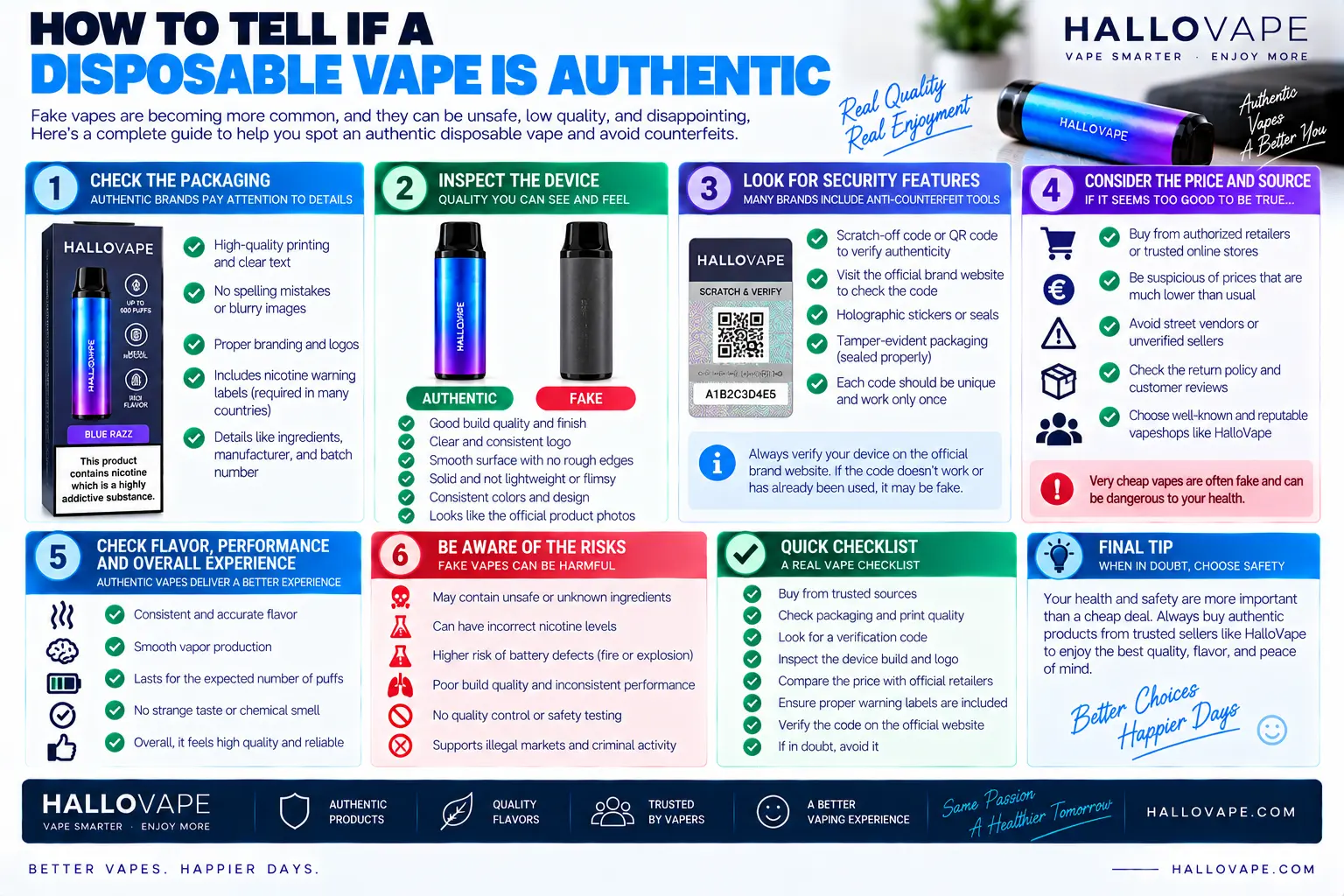
How to Tell if a Disposable Vape Is Authentic: Counterfeit & Verification Guide
When buying a disposable vape, one of the most important questions is whether the product is genuine. Counterfeit products can imitate the packaging, branding and appearance of legitimate devices, making it difficult to judge authenticity from a quick visual inspection.
There is no single visual feature that can prove a disposable vape is authentic. The safest approach is to compare several independent details: the packaging, manufacturer information, verification system, product specifications, printing quality, seals, labeling, seller and purchase circumstances.
Why Does Disposable Vape Authenticity Matter?
Authenticity matters because consumers expect a genuine product to correspond to the manufacturer's stated specifications, labeling and quality controls.
A counterfeit device may use copied branding while having different internal components, labeling or liquid characteristics. A consumer cannot reliably determine the contents or construction of an unknown product simply by looking at its exterior.
For this reason, authenticity checking should focus on traceable manufacturer information rather than appearance alone.
Can You Tell if a Disposable Vape Is Real Just by Looking at It?
Not reliably.
Counterfeit products can copy colors, logos, fonts, box layouts and device shapes. A package can look convincing and still require further verification.
Visual inspection is useful for finding warning signs, but it should be treated as one part of an authenticity check.
1. Check the Packaging Quality
Start with the outer packaging.
Look for obvious inconsistencies such as:
- Blurry or poorly printed text.
- Misspelled words.
- Incorrect product names.
- Inconsistent fonts.
- Misaligned labels.
- Low-quality graphics.
- Damaged or suspicious seals.
- Information that conflicts between different sides of the package.
Good packaging quality does not prove authenticity, but poor or inconsistent packaging can be a reason to investigate further.
2. Look for Manufacturer Information
A legitimate product should normally provide identifiable manufacturer or responsible-company information appropriate to the market in which it is sold.
Check the package for details such as the manufacturer name, product name, model information, warnings, required labeling and other information supplied for that market.
Compare the information with the manufacturer's official product information when available.
3. Check for an Official Verification System
Some manufacturers provide a product-verification system using a code, QR code, serial number or another identifier.
If the manufacturer provides such a system, use the official verification method rather than relying on a random website that claims to check the product.
Follow the manufacturer's instructions exactly.
If a verification page reports that a code is invalid, already checked unusually many times, or does not correspond to the expected product, treat that as a warning sign and contact the manufacturer or seller for clarification.
4. Make Sure the Verification Website Is Genuine
A common mistake is searching for a verification page and choosing the first website that looks convincing.
Instead, start from the manufacturer's official website or documentation and locate its verification service from there.
Be cautious with websites that:
- Use a brand name but have an unrelated domain.
- Ask for unnecessary personal information.
- Claim that every code is genuine without providing meaningful verification.
- Redirect through suspicious pages.
- Contain obvious spelling or design problems.
The source of the verification system is important because counterfeit products can also be accompanied by fake verification websites.
5. Compare the Product Name and Specifications
Check whether the product's printed specifications match information published by the manufacturer.
Useful details may include:
- Model name.
- Puff-count category.
- E-liquid capacity.
- Nicotine information.
- Battery information.
- Charging capability.
- Flavor name.
- Color or edition.
Do not assume that two products are identical simply because they have similar puff-count labels.
Our guide to choosing a disposable vape explains why puff count should be considered alongside the complete product specifications.
6. Check the Label Carefully
Read the label rather than relying on the appearance of the box.
Look for consistency between the package and device. A mismatch in product name, nicotine information, capacity, flavor or model number can be a reason to investigate.
Do not attempt to determine authenticity by tasting an unknown product. Flavor or throat sensation cannot reliably prove what is inside a device.
7. Inspect the Printing and Graphics
Counterfeit packaging may reproduce the general appearance of a legitimate product while showing small printing differences.
Look closely at:
- Logo proportions.
- Font spacing.
- Text alignment.
- Image sharpness.
- Color consistency.
- Barcode or identifier placement.
- Warning-label formatting.
One small difference is not automatically proof of a counterfeit because packaging can change between production batches or markets. The important point is whether multiple details conflict with official information.
8. Check the Device Against Official Product Images
If the manufacturer publishes product images, compare the physical device with those images.
Pay attention to:
- Logo placement.
- Device shape.
- Color and finish.
- Mouthpiece design.
- Charging-port location if applicable.
- Screen or indicator layout.
- Printed model information.
Do not expect every photograph online to be identical. Manufacturers can update packaging or produce regional variants. Official manufacturer information should take priority over random marketplace photographs.
9. Check the Seller
The seller is an important part of the authenticity picture.
A product purchased through an established retailer with clear business information, customer support and traceable purchase documentation provides more accountability than a product from an unknown source.
Be cautious when a seller:
- Cannot explain where the product came from.
- Uses copied product descriptions.
- Provides no meaningful contact information.
- Offers products at unusually low prices without a clear explanation.
- Refuses to provide basic product or purchase information.
Seller reputation does not prove that every individual product is genuine, but it is useful evidence when combined with product verification.
10. Be Careful With Prices That Look Too Good to Be True
Price alone cannot prove that a disposable vape is counterfeit.
Discounts can be legitimate because of promotions, clearance, market differences or other commercial reasons.
However, an unusually large price difference should encourage additional checking. Compare the product specifications, seller information, packaging and manufacturer verification rather than making a decision from price alone.
11. Check the Barcode and Other Identifiers
Barcodes, batch numbers, serial numbers and other identifiers can be useful when the manufacturer uses them as part of its traceability system.
Do not assume that the presence of a barcode proves authenticity. A counterfeit manufacturer can copy a printed code.
The useful question is whether the identifier can be verified through a legitimate manufacturer-controlled system or otherwise corresponds with the product information.
12. Watch for Duplicate or Suspicious Verification Codes
If a product uses a one-time or limited verification code, unusual verification behavior can be a warning sign.
For example, a code that has already been checked repeatedly may deserve further investigation.
However, verification systems differ. Some legitimate systems may allow repeated checks or may use different rules for different markets.
Follow the manufacturer's explanation instead of assuming that one verification result has the same meaning for every brand.
13. Check the Product for Physical Damage or Alteration
Authenticity and physical safety are separate questions.
A genuine product can still be damaged, while a counterfeit product can appear physically intact.
Before using a device, look for:
- Cracks.
- Swelling.
- Severe dents.
- Leaking liquid.
- Loose components.
- Unusual smell.
- Signs of tampering.
- Unusual heat.
If a device appears unsafe, do not use it simply because its packaging appears genuine.
See our guide on why disposable vapes leak for more information about leakage and abnormal device behavior.
14. Does Puff Count Prove Authenticity?
No.
A label such as 5K, 10K, 12K or 18K describes an advertised puff category. It does not independently prove that the device is genuine.
A counterfeit product can print the same puff number on its packaging.
Likewise, receiving fewer or more usable puffs than expected does not automatically prove that a product is fake because real-world puff counts vary with draw duration, device characteristics and usage.
Read our guide to what 10K puffs means for a detailed explanation of puff-count labels.
15. Does Nicotine Strength Prove Authenticity?
No.
Nicotine concentration is a product specification, not an authenticity certificate.
Do not try to identify a genuine product from how strong the nicotine feels. Sensation can vary because of nicotine formulation, concentration, flavor, airflow, heating characteristics and individual sensitivity.
For more information, read our guide to what vape strength means.
16. Can Flavor Prove That a Vape Is Genuine?
No.
Flavor is not a reliable authenticity test.
A genuine product can taste different because of batch differences, storage conditions, formulation, device performance or user perception. A counterfeit product may also attempt to imitate a popular flavor.
Authenticity should be checked through product information, manufacturer verification and purchase source rather than taste.
17. What If the Packaging Looks Genuine but the Device Seems Different?
Do not ignore a mismatch.
Compare the device with the manufacturer's official information and check the model, identifiers and verification system if available.
Packaging can sometimes change between production runs or regions, so one difference does not automatically prove counterfeiting. Multiple unexplained inconsistencies are more significant.
18. What If the Verification Code Says the Product Is Genuine?
A successful result is useful evidence, but you should still check whether the product information and physical device are consistent with the verified product.
Make sure you reached the verification system through an official manufacturer source and that the verified product corresponds to the model in your hands.
If the verification result and physical product conflict, contact the manufacturer or retailer before using the product.
19. What If There Is No Verification Code?
Not every manufacturer or product uses a public verification code.
The absence of a verification code is therefore not automatically proof that a product is counterfeit.
Use other available evidence: official product information, packaging, manufacturer details, seller information, identifiers and purchase documentation.
20. What Should You Do If You Suspect a Counterfeit Vape?
If several warning signs make you question the product's authenticity, do not rely on guesswork.
- Keep the product and packaging.
- Record the model name and any visible identifiers.
- Take clear photographs of the package and device.
- Check the manufacturer's official information.
- Use the manufacturer's official verification system if available.
- Contact the manufacturer or retailer for clarification.
- Keep your purchase receipt or order information.
- Do not use a product that appears unsafe or significantly altered.
Common Signs That Deserve Extra Attention
No single sign proves that a vape is counterfeit, but several signs together should prompt additional checking.
- Misspelled product or brand information.
- Low-quality printing.
- Packaging that differs significantly from official examples.
- Unclear manufacturer information.
- Verification results that do not match the product.
- Identifiers that cannot be explained.
- Specifications that conflict with official information.
- Unusually low pricing combined with an unknown seller.
- Signs of tampering.
- Physical behavior that appears abnormal.
Counterfeit vs. Genuine: What Should You Compare?
| Check | What to Look For |
|---|---|
| Packaging | Clear printing, consistent information and expected seals |
| Manufacturer | Identifiable company and product information |
| Verification | Official manufacturer-controlled verification when available |
| Specifications | Model, capacity, nicotine and other details matching official information |
| Identifiers | Barcode, batch or serial information that can be meaningfully checked |
| Seller | Traceable retailer and purchase documentation |
| Physical condition | No swelling, leakage, severe damage or obvious tampering |
Why Online Marketplace Photos Are Not Enough
Product photographs on marketplaces can be outdated, supplied by third parties or copied from official listings.
A photograph can therefore help you compare appearance but should not be treated as proof that the physical product you receive is genuine.
When authenticity matters, compare the actual product and packaging with current information from the manufacturer.
What About Regional Packaging Differences?
Packaging can vary between countries, languages and regulatory markets.
Different warning statements, responsible-company information, languages or labeling formats do not automatically mean that a product is counterfeit.
Before treating a difference as suspicious, check whether the manufacturer publishes regional versions or market-specific information.
Can an Authentic Vape Still Be Unsafe?
Yes.
Authenticity does not eliminate the possibility of damage, manufacturing defects, poor storage or battery problems.
If a genuine device becomes unusually hot, swollen, damaged, smoky or heavily leaky, stop using it and follow the manufacturer's safety guidance.
Our guide on why a disposable vape gets hot explains warning signs associated with unusual heat.
How to Buy With More Confidence
A practical authenticity checklist is:
- Choose a traceable retailer.
- Keep the receipt or order confirmation.
- Inspect the package before opening or using the product.
- Compare the model with official manufacturer information.
- Check the manufacturer's verification system when available.
- Compare the specifications and identifiers.
- Do not rely on price, flavor or puff count alone.
- Do not use a product that appears damaged or unsafe.
Frequently Asked Questions
1. How can I tell if a disposable vape is authentic?
Check the packaging, manufacturer information, product specifications, identifiers, seller and any official verification system. No single visual feature proves authenticity.
2. Can a QR code prove that a disposable vape is genuine?
A QR code can be useful when it leads to an official manufacturer-controlled verification system, but the code itself is not proof. Start from the manufacturer's official website when locating a verification service.
3. What if my verification code does not work?
Do not assume the product is genuine or counterfeit from one result alone. Check that you used the official verification system and contact the manufacturer or retailer if the result remains unclear.
4. Does a cheap disposable vape mean it is fake?
No. Discounts and promotions can be legitimate. However, an unusually low price combined with an unknown seller or other inconsistencies is a reason to investigate further.
5. Can flavor tell me whether a disposable vape is fake?
No. Flavor is not a reliable authenticity test. Taste can vary for many reasons, including formulation, storage, device performance and individual perception.
6. Does the puff count prove a vape is genuine?
No. Puff count is an advertised product specification and can be copied onto counterfeit packaging. It should not be used as an authenticity certificate.
7. Does nicotine strength prove a disposable vape is authentic?
No. Nicotine strength describes product concentration and does not independently establish authenticity.
8. What should I do if I think my disposable vape is counterfeit?
Keep the packaging, record the product identifiers, compare the product with official manufacturer information, use the official verification system if available, and contact the manufacturer or retailer. Do not use a product that appears unsafe.
9. Can genuine packaging contain a counterfeit device?
It is possible for packaging and product components to be altered or mismatched. That is why the physical device, identifiers and official verification should also be considered rather than judging the box alone.
10. Can an authentic disposable vape still be dangerous?
Yes. Authenticity does not prevent damage, battery failure, leakage or other faults. If a device becomes unusually hot, swollen, smoky, damaged or heavily leaky, stop using it.
Conclusion
Learning how to tell if a disposable vape is authentic is less about spotting one magic detail and more about checking several pieces of evidence together.
Start with the manufacturer's official information. Examine the packaging, compare product specifications, check identifiers and use an official verification system when one is available. Consider the seller and keep purchase documentation as well.
Do not rely solely on price, flavor, puff count, nicotine sensation, packaging appearance or a QR code. Counterfeit products can imitate individual features, so independent checks provide a stronger basis for evaluating authenticity.
Finally, remember that authenticity and safety are separate issues. Even a genuine device should not be used if it is damaged, swollen, leaking, unusually hot or otherwise behaving abnormally.
For more information, continue with our guides on how to choose a disposable vape, vape strength, and disposable vape overheating.


