What Does Vape Strength Mean? Nicotine Levels Explained
Vape strength usually refers to the amount or concentration of nicotine in a vape. This guide explains nicotine percentages, mg/mL, nicotine salts, zero-nicotine products and how strength differs from puff count and e-liquid capacity.
# What Does Vape Strength Mean? Nicotine Levels Explained
If you have ever looked at a disposable vape package and wondered what a number such as 0%, 2%, 3% or 5% means, you are looking at the product's nicotine strength.
Vape strength generally describes how much nicotine is present in the e-liquid. It is one of the most important specifications to understand when comparing vaping products because nicotine strength is completely different from puff count, e-liquid capacity and battery size.
The label can be confusing because manufacturers and markets may express nicotine concentration in different ways. Some products use a percentage, while others use milligrams per milliliter (mg/mL). Nicotine salts and freebase nicotine can also provide different experiences at the same or similar labeled concentration.
This guide explains what vape strength means, how percentages relate to mg/mL, what common labels mean, how nicotine salts fit into the picture and why you should always check the exact product information rather than guessing from a device's size or puff count.
If you are new to e-liquid, first read our guide on [what vape juice is](https://hallovape.com/blog/what-is-vape-juice/) and our article explaining [what is inside a disposable vape](https://hallovape.com/blog/what-is-inside-a-disposable-vape/).
## What Does Vape Strength Mean?
Vape strength usually refers to the concentration of nicotine in an e-liquid.
It does not refer to:
- Puff count.
- Battery capacity.
- Device size.
- Vapor volume.
- Flavor intensity.
- How powerful the heating element is.
For example, a disposable vape can have a high puff count but a relatively low nicotine concentration, or a smaller device can contain a higher nicotine concentration.
The nicotine strength must therefore be checked separately from the other specifications.
## How Is Vape Strength Measured?
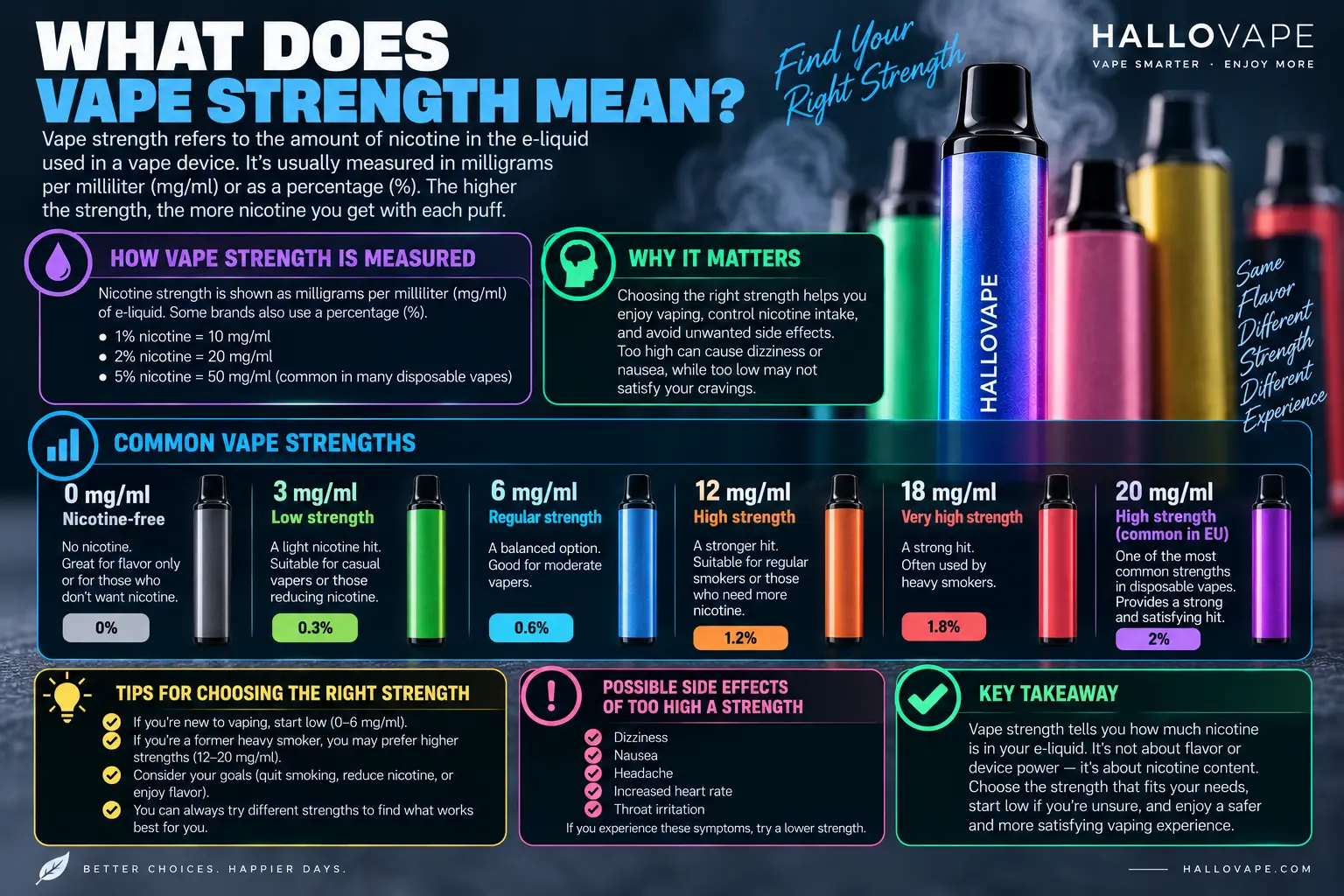
Nicotine concentration is commonly displayed in two formats:
- Percentage (%).
- Milligrams per milliliter (mg/mL).
The exact labeling convention depends on the product and market.
A useful conversion for many standard e-liquid labels is:
**1% nicotine ≈ 10 mg/mL**
So, as a mathematical concentration conversion:
| Nicotine percentage | Approximate concentration |
|---:|---:|
| 0% | 0 mg/mL |
| 0.5% | 5 mg/mL |
| 1% | 10 mg/mL |
| 2% | 20 mg/mL |
| 3% | 30 mg/mL |
| 4% | 40 mg/mL |
| 5% | 50 mg/mL |
This table is a concentration conversion, not a recommendation about which strength someone should use.
Always use the actual labeling on the product you are buying because regulations, labeling practices and formulations can differ.
## What Does 5% Nicotine Mean?
A label of 5% generally corresponds to approximately 50 mg/mL nicotine concentration.
The percentage describes concentration in the liquid, not the amount of nicotine that every puff delivers.
This distinction is important.
A device labeled 5% does not mean that each puff contains 5% nicotine.
It means the e-liquid has a nicotine concentration represented by that percentage.
Actual nicotine exposure from using a device depends on factors such as the amount of liquid consumed, puff duration, device characteristics and individual use.
For a dedicated explanation, read [what 5% nicotine means in a disposable vape](https://hallovape.com/blog/what-does-5-nicotine-mean-in-a-disposable-vape/) when available on the blog.
## What Does 2% Nicotine Mean?
A 2% nicotine label generally corresponds to approximately 20 mg/mL.
Again, this describes the concentration of nicotine in the liquid.
It does not mean that a fixed amount is delivered with every puff.
Different devices can aerosolize different amounts of liquid per draw, so two products with the same labeled nicotine concentration may not necessarily result in identical nicotine exposure.
## What Does 0% Nicotine Mean?
A product labeled 0% is intended to contain no nicotine according to its labeling.
Zero-nicotine products are different from products that contain nicotine even when they have the same flavor, puff count or device design.
If avoiding nicotine is important, check the product's packaging and manufacturer information carefully.
Do not assume that a product is nicotine-free simply because nicotine is not mentioned prominently in its marketing.
## What Does mg/mL Mean?
mg/mL means milligrams per milliliter.
It describes the concentration of nicotine in the liquid.
For example, 20 mg/mL means that there are 20 milligrams of nicotine represented in each milliliter of e-liquid.
This is a concentration measurement.
It should not be confused with the total amount of nicotine in the entire device.
If a device contains multiple milliliters of liquid, the total nicotine content represented by the liquid concentration will depend on the total liquid volume.
## Nicotine Concentration vs. Total Nicotine
These are two different concepts.
**Nicotine concentration** tells you how much nicotine is present per unit of liquid.
**Total nicotine content** depends on both concentration and the total amount of e-liquid.
For example, if a liquid is labeled 20 mg/mL and a device contains 2 mL of liquid, the nominal nicotine amount represented by the liquid is:
20 mg/mL × 2 mL = 40 mg
This does not mean the user absorbs 40 mg.
It is simply the amount represented in the liquid based on its labeled concentration and volume.
Actual nicotine absorption is a separate question.
## Does Higher Vape Strength Mean More Vapor?
No.
Nicotine strength and vapor production are different characteristics.
Vapor production is affected by the heating system, power, airflow, liquid formulation and other device characteristics.
A higher nicotine concentration does not automatically make a device produce more visible vapor.
Likewise, a device producing a large cloud does not necessarily have a high nicotine concentration.
## Does Higher Vape Strength Mean Stronger Flavor?
Not necessarily.
Nicotine concentration can influence the overall sensory experience, but flavor is primarily determined by the flavoring formulation and how the device heats and delivers the liquid.
Two products can have the same nicotine strength but completely different flavors.
Likewise, the same flavor can be offered at different nicotine strengths.
## Does Puff Count Tell You Nicotine Strength?
No.
Puff count and nicotine strength are separate specifications.
A product advertised as 5K, 10K, 12K or 18K puffs does not automatically have a particular nicotine concentration.
For example, a 10K device could be sold with a nicotine strength specified separately by the manufacturer.
Our guide to [what 10K puffs means](https://hallovape.com/blog/what-does-10k-puffs-mean-on-a-disposable-vape/) explains why puff-count labels should not be confused with nicotine specifications.
## Does a Bigger Disposable Vape Have Stronger Nicotine?
Not automatically.
A larger device may contain more e-liquid or a larger battery, but physical size does not determine nicotine concentration.
The only reliable way to determine the labeled nicotine strength is to check the product information.
This is particularly important when comparing high-capacity disposable vapes.
## What Is Nicotine Salt?
Nicotine salt is a type of nicotine formulation used in many modern vaping products.
It is chemically different from traditional freebase nicotine.
Nicotine salts are commonly used in pod-style devices and disposable vapes, particularly products designed around higher nicotine concentrations.
Many users describe nicotine salt formulations as smoother at higher concentrations than comparable freebase formulations, although the actual experience depends on the formulation and device.
Nicotine salt should therefore be understood as a type of nicotine formulation, not as a specific strength.
## Nicotine Salt vs. Freebase Nicotine
The two terms describe different nicotine formulations.
| Feature | Nicotine salts | Freebase nicotine |
|---|---|---|
| Nicotine formulation | Salt-based formulation | Traditional freebase formulation |
| Common use | Many modern disposables and pods | E-liquids and some devices |
| Higher concentrations | Commonly used | Often associated with lower concentrations |
| Sensation | Often perceived as smoother at higher strengths | Can feel more noticeable or harsh at higher strengths |
The exact experience varies with concentration, formulation, flavor, device power and airflow.
There is no universal rule that one type will feel the same for every user.
## Is Nicotine Salt Stronger Than Freebase Nicotine?
Not simply because it is a nicotine salt.
Strength is determined by nicotine concentration.
Nicotine type can influence how the liquid feels and how the nicotine is delivered, but a label such as 20 mg/mL describes concentration regardless of whether the formulation uses nicotine salt or another form.
The formulation and device should therefore be considered together.
## Why Do Nicotine Salts Feel Smoother?
Nicotine salt formulations are commonly associated with a smoother throat sensation at higher nicotine concentrations.
The formulation can alter the pH and overall characteristics of the liquid.
However, "smoother" does not mean weaker.
A smoother sensation can make a higher nicotine concentration feel less harsh, which is one reason users should not judge nicotine strength by throat sensation alone.
## Can You Taste Nicotine Strength?
Sometimes nicotine concentration can affect the sensory experience, but taste is not a reliable way to determine strength.
Flavoring, PG/VG ratio, cooling ingredients, nicotine type and device characteristics all influence the experience.
A vape that feels smooth is not necessarily low in nicotine.
Always use the labeled concentration instead of trying to estimate strength from taste.
## Why Does a High-Nicotine Vape Sometimes Feel Harsh?
A harsh sensation can have multiple causes.
Possible factors include:
- Higher nicotine concentration.
- Nicotine formulation.
- PG proportion.
- Flavoring.
- Heating conditions.
- Airflow.
- Individual sensitivity.
If a product feels unexpectedly harsh, check the labeled nicotine strength and the complete product specifications.
Do not assume that harshness alone tells you the exact concentration.
## What Is the Difference Between Strength and E-Liquid Capacity?
Nicotine strength describes concentration.
E-liquid capacity describes how much liquid the device contains.
For example:
- **5%** describes nicotine concentration.
- **2 mL** describes liquid volume.
- **10K puffs** describes an advertised puff capacity.
- **650 mAh** describes battery capacity.
These specifications measure different things.
Keeping them separate makes product comparisons much easier.
## What Is the Difference Between Strength and Puff Count?
Puff count estimates how many draws a product may provide under the manufacturer's testing conditions.
Nicotine strength describes the nicotine concentration of the liquid.
Neither specification tells you the other.
A high puff count does not necessarily mean high nicotine.
A high nicotine concentration does not necessarily mean a high puff count.
## What Is the Difference Between Strength and Battery Capacity?
Battery capacity is commonly expressed in mAh.
It describes electrical storage capacity.
Nicotine strength describes the concentration of nicotine in the e-liquid.
A larger battery may help support longer device operation, but it does not automatically mean stronger nicotine.
## How Does Vape Strength Relate to E-Liquid?
The nicotine is contained in the e-liquid.
Therefore, nicotine strength is directly related to the liquid formulation.
If the concentration is higher, each milliliter of liquid contains more nicotine.
However, total nicotine in a device also depends on how much liquid the device contains.
This is why both concentration and e-liquid volume can matter when reading product specifications.
## How Much Nicotine Is in a Disposable Vape?
There is no single answer.
Disposable vapes are sold in different nicotine strengths and liquid capacities.
To estimate the nominal nicotine amount represented in the liquid, multiply:
**nicotine concentration × e-liquid volume**
For example, 20 mg/mL × 2 mL equals 40 mg of nicotine represented in the liquid.
That figure should not be interpreted as the amount absorbed by the user.
Actual absorption varies substantially depending on use and other factors.
## Why Can Two Vapes With the Same Strength Feel Different?
The labeled nicotine concentration may be the same while the overall experience differs.
Reasons can include:
- Different nicotine formulations.
- Different PG/VG ratios.
- Different flavorings.
- Different heating systems.
- Different power levels.
- Different airflow.
- Different puff duration.
Therefore, nicotine strength is important, but it is not the only specification that determines how a product feels.
## Can Nicotine Strength Change Over Time?
The labeled nicotine concentration is determined by the product formulation, but e-liquid can undergo changes during storage.
Exposure to heat, light and air can affect e-liquid characteristics over time.
This is another reason to follow the manufacturer's storage recommendations.
Avoid leaving disposable vapes in hot cars, direct sunlight or other extreme environments.
If a product shows unusual changes in appearance, smell, leakage or device condition, do not assume the issue is simply a change in nicotine strength.
## How Should You Read a Disposable Vape Label?
Look for several separate specifications.
### 1. Nicotine strength
Usually shown as a percentage or mg/mL.
### 2. Nicotine type
The product may identify nicotine salt or another formulation.
### 3. E-liquid capacity
This indicates how much liquid is contained in the device.
### 4. Puff count
This is generally an advertised estimate.
### 5. Battery capacity
Rechargeable models may list battery capacity.
### 6. Flavor
This describes the intended flavor profile, not nicotine strength.
Reading these specifications separately prevents many common misunderstandings.
## Common Vape Strength Labels Explained
Here are examples of common percentage labels and their approximate concentration equivalents:
### 0%
Approximately 0 mg/mL.
This indicates a nicotine-free product according to its label.
### 1%
Approximately 10 mg/mL.
### 2%
Approximately 20 mg/mL.
### 3%
Approximately 30 mg/mL.
### 4%
Approximately 40 mg/mL.
### 5%
Approximately 50 mg/mL.
These are mathematical conversions using the common relationship between percentage and mg/mL.
Always check the exact product labeling and applicable market requirements.
## What Does "Nicotine Free" Mean?
A nicotine-free product is intended to contain no nicotine according to its labeling.
The absence of nicotine does not mean the device is identical to a nicotine-containing product in every other respect.
It may still contain e-liquid ingredients and flavoring compounds.
If you specifically need a nicotine-free product, verify the label and manufacturer information rather than relying on assumptions.
## Can Nicotine Strength Be Changed in a Disposable Vape?
A disposable vape is generally manufactured with a fixed e-liquid formulation.
Unlike a refillable system, the user normally cannot adjust the nicotine concentration.
Do not attempt to open the device and add another liquid.
Doing so can damage the device and create battery, leakage and performance risks.
If someone needs a different nicotine concentration, the appropriate approach is to choose a product designed and labeled with the desired concentration rather than modifying a sealed disposable.
## Can You Mix Different Nicotine Strengths?
Mixing liquids is relevant to refillable systems, not sealed disposable devices.
A disposable vape should not be opened and mixed with another liquid.
For refillable products, mixing requires understanding the concentration and volume of each liquid, but that is a separate topic from using a pre-filled disposable.
## Is 5% the Same as 50 mg/mL?
Under the common concentration conversion, yes:
**5% ≈ 50 mg/mL**
This is why a product may display either 5% or 50 mg/mL depending on its labeling system.
However, always rely on the actual label and applicable regulations for the specific product.
## Is 2% the Same as 20 mg/mL?
Under the same conversion:
**2% ≈ 20 mg/mL**
Again, this describes concentration in the liquid.
It does not mean that every puff delivers 20 mg.
## Is Higher Nicotine Strength Better?
There is no universal "best" nicotine strength.
The appropriate product depends on the individual, the product's intended market and applicable regulations.
Nicotine is addictive, and people who do not already use nicotine should not start using nicotine products.
For adult nicotine users who are comparing products, the safest approach is to read the actual labeled concentration and avoid guessing from flavor, device size or puff count.
## What Strength Should a Beginner Choose?
There is no single strength that can responsibly be recommended for every beginner.
People have different levels of nicotine exposure, different product preferences and different responses.
Someone who does not already use nicotine should not begin vaping.
If you are an adult who already uses nicotine and is comparing products, use the labeled concentration, follow local requirements and avoid assuming that a higher strength is automatically better.
## Can High Nicotine Strength Cause More Nicotine Exposure?
A higher concentration means more nicotine per unit of liquid.
However, exposure also depends on how much liquid is consumed and how the device is used.
Factors can include:
- Puff frequency.
- Puff duration.
- Device power.
- Liquid consumption.
- Individual inhalation behavior.
Therefore, concentration alone does not provide an exact measurement of how much nicotine a person absorbs.
## How Can You Compare Vape Strengths Safely?
Start with the label.
Then compare:
1. Nicotine concentration.
2. Nicotine formulation.
3. E-liquid capacity.
4. Puff estimate.
5. Device characteristics.
6. Manufacturer information.
Do not compare only the percentage.
A complete comparison provides a much clearer picture.
## Vape Strength and the JNR Alien 10K
The [JNR Alien 10K](https://hallovape.com/en/product/jnr-alien-10k/) is an example of a high-capacity disposable vape product.
When evaluating it or any similar device, nicotine strength should be read from its actual product specifications.
The "10K" designation describes the advertised puff category and should not be interpreted as a nicotine-strength measurement.
Always check the specific product listing and packaging for nicotine information.
## Why Nicotine Strength Is Only One Specification
A disposable vape is a complete system.
Its experience can be influenced by:
- E-liquid formulation.
- Nicotine concentration.
- Nicotine type.
- Flavoring.
- Heating element.
- Battery.
- Airflow.
- Mouthpiece.
- Puff duration.
This is why a product comparison based only on nicotine percentage can be incomplete.
If you are choosing between products, our [disposable vape buying guide](https://hallovape.com/blog/how-to-choose-a-disposable-vape/) explains other specifications worth considering.
## Frequently Asked Questions
### What does vape strength mean?
Vape strength generally refers to the nicotine concentration in the e-liquid. It is commonly expressed as a percentage or in mg/mL.
### What does 5% nicotine mean?
A 5% nicotine label generally corresponds to approximately 50 mg/mL. It describes the concentration of nicotine in the liquid, not the amount delivered by each puff.
### What does 2% nicotine mean?
A 2% nicotine label generally corresponds to approximately 20 mg/mL. It describes liquid concentration rather than a fixed amount absorbed per puff.
### Is 5% nicotine the same as 50 mg/mL?
Under the common percentage-to-concentration conversion, yes. 5% is approximately 50 mg/mL.
### Is 2% nicotine the same as 20 mg/mL?
Yes, under the same standard conversion, 2% is approximately 20 mg/mL.
### Does a higher puff count mean stronger nicotine?
No. Puff count and nicotine concentration are separate specifications. A high-puff device can have different nicotine strengths depending on the product.
### Does a bigger vape have more nicotine?
Not necessarily. Device size does not determine nicotine concentration. Check the actual nicotine specification.
### What is the difference between nicotine salt and freebase nicotine?
They are different nicotine formulations. Nicotine salts are commonly used in modern disposables and can feel smoother at higher concentrations, while freebase nicotine is a traditional formulation.
### Does higher nicotine mean more vapor?
No. Nicotine concentration and vapor production are separate characteristics. Vapor depends more on the device's heating system, power, airflow and liquid formulation.
### Can you change the nicotine strength of a disposable vape?
A sealed disposable is generally not designed for user adjustment. Do not open it or add another liquid. Choose a product that is manufactured and labeled with the desired strength instead.
## Conclusion
Vape strength is primarily a way of describing nicotine concentration in an e-liquid.
The two most common ways to express it are percentage and milligrams per milliliter. As a general mathematical conversion, 1% is approximately 10 mg/mL, so 2% is about 20 mg/mL and 5% is about 50 mg/mL.
The important point is that nicotine strength is only one specification. It is separate from puff count, e-liquid capacity, battery capacity, device size and flavor.
Nicotine salts and freebase nicotine are also different formulations, and the type of nicotine can influence the overall experience. A smoother sensation does not necessarily mean a lower nicotine concentration.
When comparing disposable vapes, read the actual product label and manufacturer information. Do not try to estimate nicotine strength from the size of the device, the number of advertised puffs or the intensity of the flavor.
Nicotine is addictive, and people who do not already use nicotine should not start using nicotine products. If you already use nicotine and are comparing products, understanding the label is the first step toward making an informed comparison.
FAQ
Frequently Asked Questions
What does vape strength mean?
Vape strength generally refers to the nicotine concentration in the e-liquid. It is commonly expressed as a percentage or in mg/mL.
What does 5% nicotine mean?
A 5% nicotine label generally corresponds to approximately 50 mg/mL. It describes the concentration of nicotine in the liquid, not the amount delivered by each puff.
What does 2% nicotine mean?
A 2% nicotine label generally corresponds to approximately 20 mg/mL. It describes liquid concentration rather than a fixed amount absorbed per puff.
Is 5% nicotine the same as 50 mg/mL?
Under the common percentage-to-concentration conversion, yes. 5% is approximately 50 mg/mL.
Is 2% nicotine the same as 20 mg/mL?
Yes, under the same standard conversion, 2% is approximately 20 mg/mL.
Does a higher puff count mean stronger nicotine?
No. Puff count and nicotine concentration are separate specifications. A high-puff device can have different nicotine strengths depending on the product.
Does a bigger vape have more nicotine?
Not necessarily. Device size does not determine nicotine concentration. Check the actual nicotine specification.
What is the difference between nicotine salt and freebase nicotine?
They are different nicotine formulations. Nicotine salts are commonly used in modern disposables and can feel smoother at higher concentrations, while freebase nicotine is a traditional formulation.
Does higher nicotine mean more vapor?
No. Nicotine concentration and vapor production are separate characteristics. Vapor depends more on the device's heating system, power, airflow and liquid formulation.
Can you change the nicotine strength of a disposable vape?
A sealed disposable is generally not designed for user adjustment. Do not open it or add another liquid. Choose a product that is manufactured and labeled with the desired strength instead.
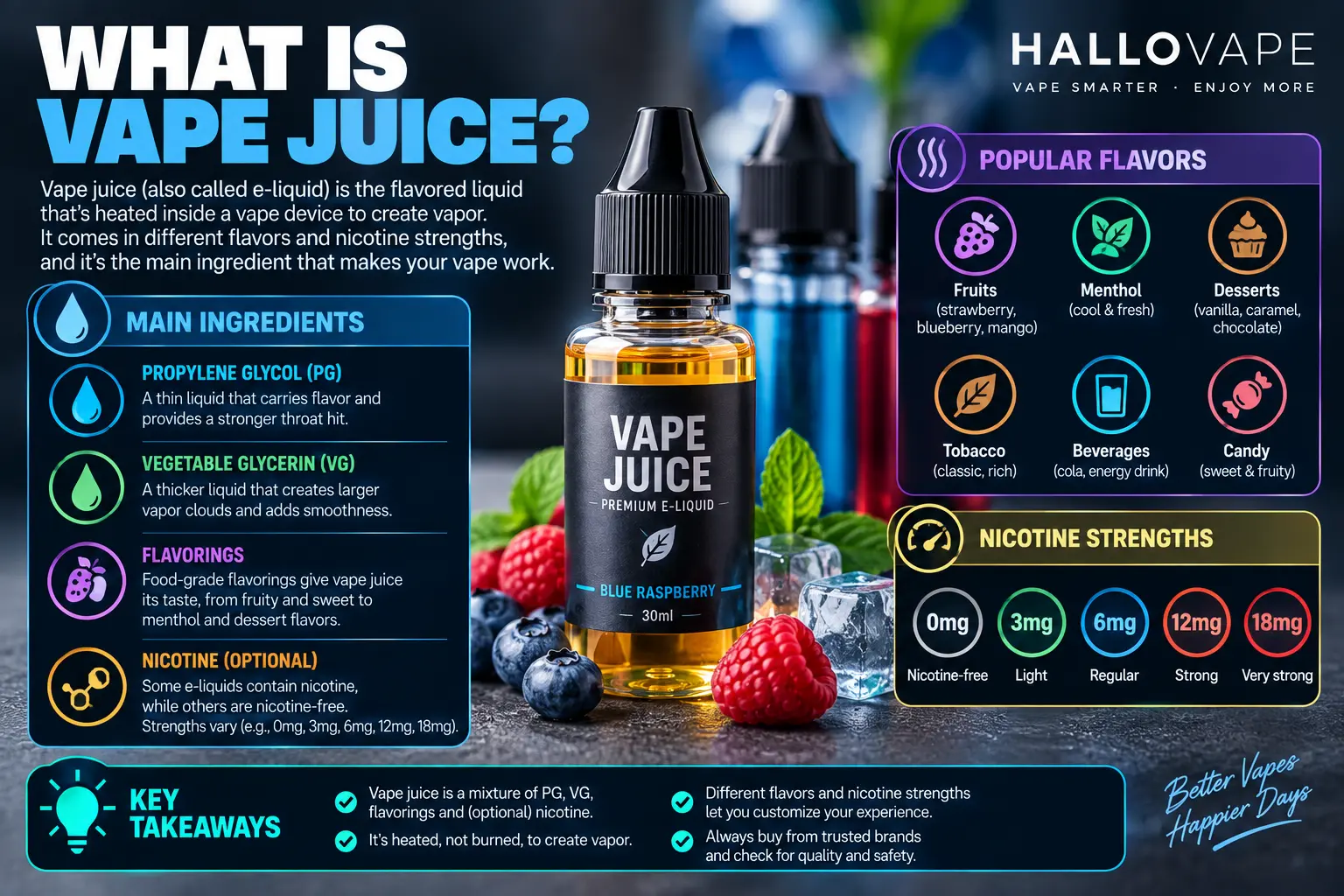
What is vape juice and what does it contain? Learn how e-liquid works inside disposable vapes, the role of propylene glycol, vegetable glycerin, flavorings and nicotine, and why vape liquid affects flavor, vapor and device performance.
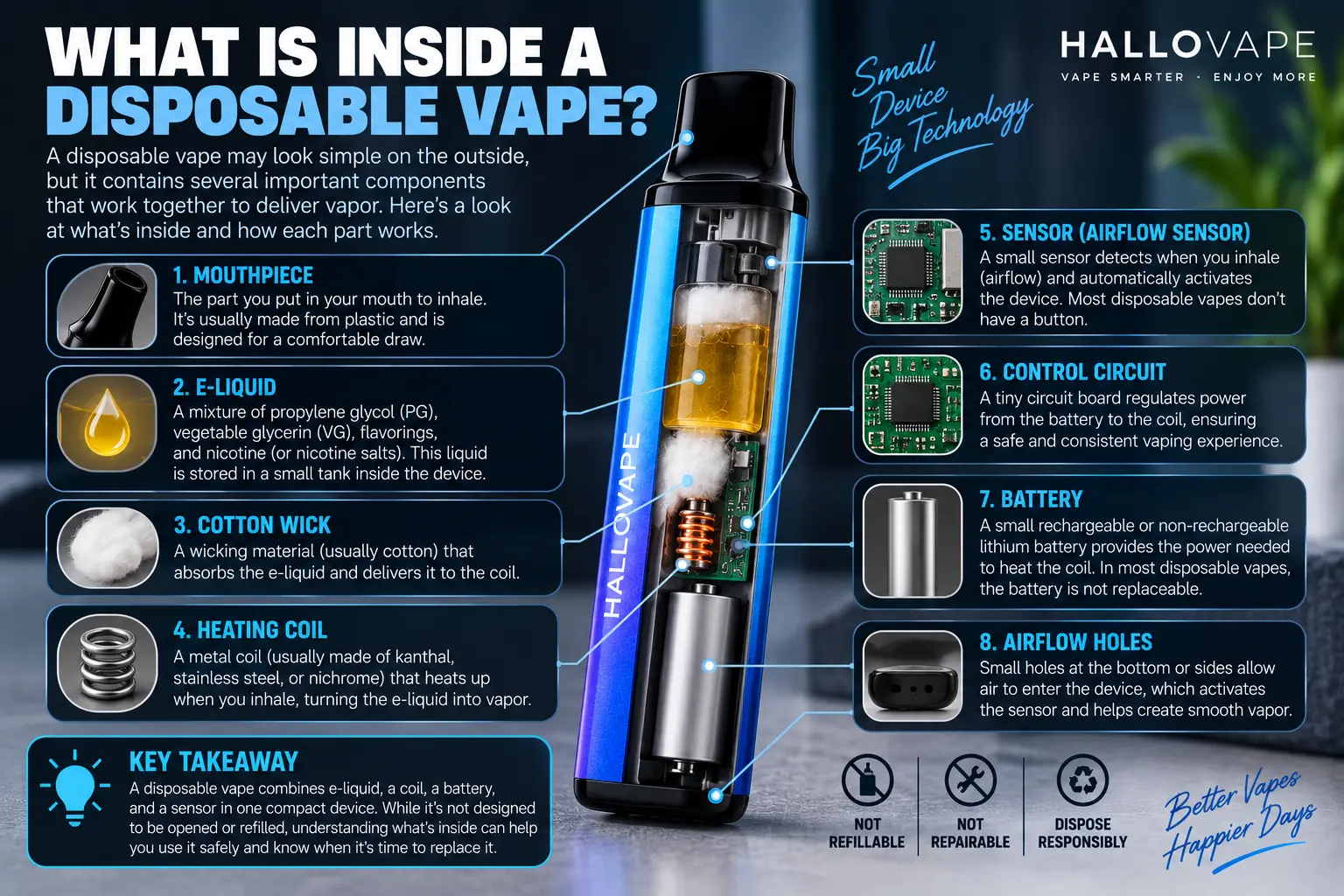
Curious about what is inside a disposable vape? This guide explains the main components, including the battery, heating coil, e-liquid reservoir, airflow system, sensor, mouthpiece and protective electronics, and how they work together.
Learn why a disposable vape can feel warm or become unusually hot. This guide explains normal heat from the coil, rapid repeated use, charging, extreme temperatures, airflow problems, battery issues and physical damage, plus the signs that mean you should stop using a device.
Explore the HalloVape shop
Read, learn and then explore the products currently available at HalloVape.