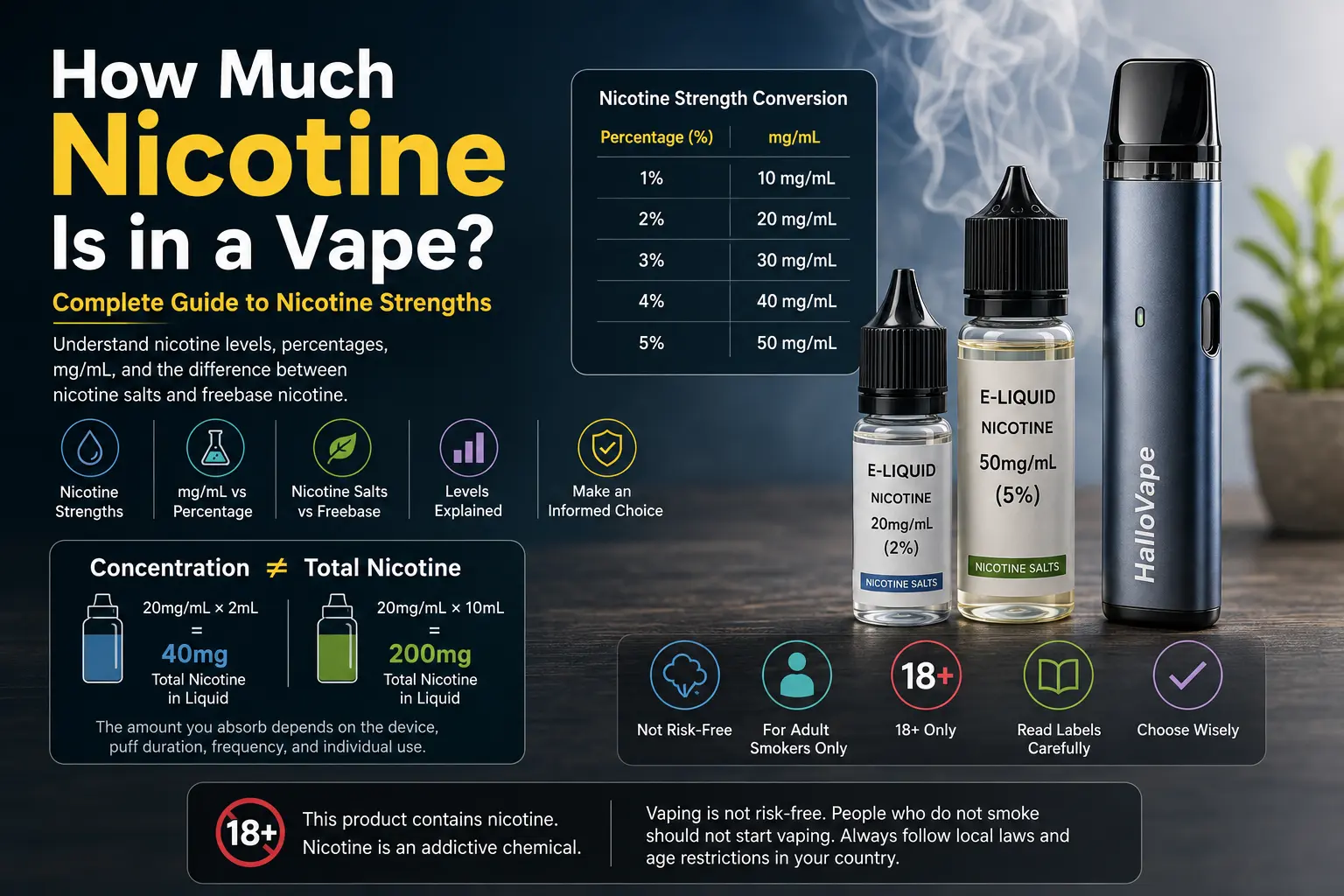
One of the most common questions people ask when they first look at vaping is simple: how much nicotine is in a vape? The answer is not always as straightforward as it seems because vape products can describe nicotine strength in different ways.
You may see labels such as 2%, 5%, 20 mg/mL or 50 mg/mL. You may also see terms such as nicotine salts and freebase nicotine. For someone comparing different products, these numbers and terms can quickly become confusing.
This guide explains what vape nicotine strengths actually mean, how percentages relate to mg/mL, why nicotine concentration is different from the total nicotine contained in a device, and how nicotine salts differ from freebase nicotine.
This article is intended for adults who already smoke or use nicotine and are researching vaping. Vaping is not risk-free, and people who do not smoke or use nicotine should not start vaping.
What Does Nicotine Strength Mean?
Nicotine strength describes the concentration of nicotine in the e-liquid or vape liquid. In simple terms, it tells you how much nicotine is present in a particular amount of liquid.
The two most common ways you will encounter nicotine strength are:
- Milligrams per millilitre (mg/mL)
- Percentage (%)
For example, a vape may be labelled as 20 mg/mL or 2%. These are commonly used ways of describing approximately the same nicotine concentration.
A product labelled 50 mg/mL may also be described as 5%.
The important point is that nicotine strength is a concentration measurement. It does not automatically tell you how much nicotine a person will absorb during vaping.
mg/mL vs. Nicotine Percentage
Understanding the relationship between mg/mL and percentages makes vape labels much easier to read.
As a general labeling conversion:
- 1% ≈ 10 mg/mL
- 2% ≈ 20 mg/mL
- 3% ≈ 30 mg/mL
- 4% ≈ 40 mg/mL
- 5% ≈ 50 mg/mL
So if you see a product labelled 20 mg/mL, it is commonly described as approximately 2% nicotine.
Likewise, a product labelled 50 mg/mL is commonly described as approximately 5% nicotine.
However, always check the actual packaging and manufacturer information because labeling requirements and product specifications can vary between markets.
Concentration Is Not the Same as Total Nicotine
This is one of the most important concepts to understand when comparing disposable vapes.
Suppose a product contains e-liquid with a nicotine concentration of 20 mg/mL. That does not mean the entire device contains only 20 mg of nicotine.
If the device contains 2 mL of e-liquid, a simple concentration calculation would be:
20 mg/mL × 2 mL = 40 mg of nicotine in the liquid.
This is the amount of nicotine contained in the liquid based on the stated concentration. It should not be interpreted as the amount that a person will necessarily absorb into their body.
That distinction becomes particularly important when comparing products with different liquid capacities.
Example: Comparing Two Vape Devices
Imagine two products:
- Device A: 2 mL of e-liquid at 20 mg/mL
- Device B: 10 mL of e-liquid at 20 mg/mL
Both products have the same nicotine concentration, but they do not contain the same total amount of nicotine in their liquid.
Using the concentration multiplied by the liquid volume:
- Device A: 20 × 2 = 40 mg
- Device B: 20 × 10 = 200 mg
This is why looking only at the percentage on a vape is not enough to understand the total nicotine contained in the device.
You also need to know the amount of e-liquid.
What Does 2% Nicotine Mean?
A vape labelled 2% nicotine generally corresponds to approximately 20 mg/mL.
The percentage describes concentration rather than total device content.
For example, if a product contains 5 mL of e-liquid at 2% nicotine, the approximate amount of nicotine contained in the liquid would be:
20 mg/mL × 5 mL = 100 mg.
Again, this is not the same as saying that the user will absorb 100 mg. Actual nicotine exposure depends on many factors, including how the device is used.
What Does 5% Nicotine Mean?
5% nicotine is commonly used to describe a concentration of approximately 50 mg/mL.
This is a relatively high nicotine concentration compared with lower-strength e-liquids, and products using this concentration are often associated with nicotine salt formulations.
When reading a label, it is important not to confuse 5% with 5 mg of nicotine in the entire device.
It describes the concentration of nicotine in the liquid.
For example, if a product contains 2 mL of liquid at 50 mg/mL:
50 mg/mL × 2 mL = 100 mg of nicotine contained in the liquid.
The amount absorbed by the user can be considerably different and depends on actual use.
20mg vs. 50mg Nicotine
One of the most common comparisons people make is between 20 mg/mL and 50 mg/mL.
In simple terms:
- 20 mg/mL ≈ 2%
- 50 mg/mL ≈ 5%
The 50 mg/mL liquid has a higher nicotine concentration than the 20 mg/mL liquid.
However, higher concentration does not automatically mean that a product is better.
The appropriate choice depends on the individual adult user's existing nicotine use, the type of device, the frequency of use and the intended purpose of switching from combustible cigarettes.
For an adult smoker who is trying to move away from cigarettes, using a nicotine level that does not adequately satisfy nicotine cravings may make switching more difficult. On the other hand, choosing a stronger product simply because the number is higher is not necessarily a good strategy either.
What Are Nicotine Salts?
Nicotine salts are a form of nicotine used in many modern vape products, particularly compact pod systems and disposable vapes.
Traditional freebase nicotine can become increasingly harsh as the concentration increases. Nicotine salt formulations were developed to provide a different vaping experience, often allowing higher nicotine concentrations with a smoother throat sensation.
Nicotine salts are commonly associated with small, convenient devices because they can provide nicotine efficiently without requiring the large vapour production associated with some high-powered devices.
However, smoother does not mean harmless.
A smoother sensation can make it easier to inhale higher-nicotine aerosol without the same throat sensation that some users experience with stronger freebase formulations.
What Is Freebase Nicotine?
Freebase nicotine is the traditional form of nicotine used in many e-liquids.
It has been used in vaping products for many years and is commonly found in lower nicotine concentrations.
Compared with nicotine salts, higher concentrations of freebase nicotine may produce a stronger throat sensation. Some experienced users prefer this sensation, while others prefer the smoother experience associated with nicotine salts.
Neither term by itself tells you whether a product is suitable for a particular person. The nicotine concentration, device design and individual use pattern all matter.
Nicotine Salts vs. Freebase Nicotine
The main differences can be summarized like this:
| Feature | Nicotine Salts | Freebase Nicotine |
|---|---|---|
| Typical use | Pods and compact devices | Many traditional e-liquids and vape devices |
| Throat sensation | Often smoother at higher strengths | Can feel stronger as concentration increases |
| Common strengths | Often available in higher concentrations | Commonly available in lower concentrations |
| Device type | Often low-power devices | Wide range of devices |
These are general characteristics rather than strict rules. Vape products differ considerably, so the actual product label should always be checked.
How Much Nicotine Do You Actually Absorb?
This is where the question becomes more complicated.
The amount of nicotine contained in vape liquid is not the same as the amount absorbed by the person using the device.
Nicotine delivery can vary depending on:
- The nicotine concentration
- The device design
- The power output
- The type of coil
- The e-liquid formulation
- The length of each puff
- How frequently the person vapes
- Individual vaping behaviour
Two people using the same device may therefore have different nicotine exposure.
This is also why puff counts should not be treated as exact measurements of nicotine intake.
Does Puff Count Tell You How Much Nicotine You Get?
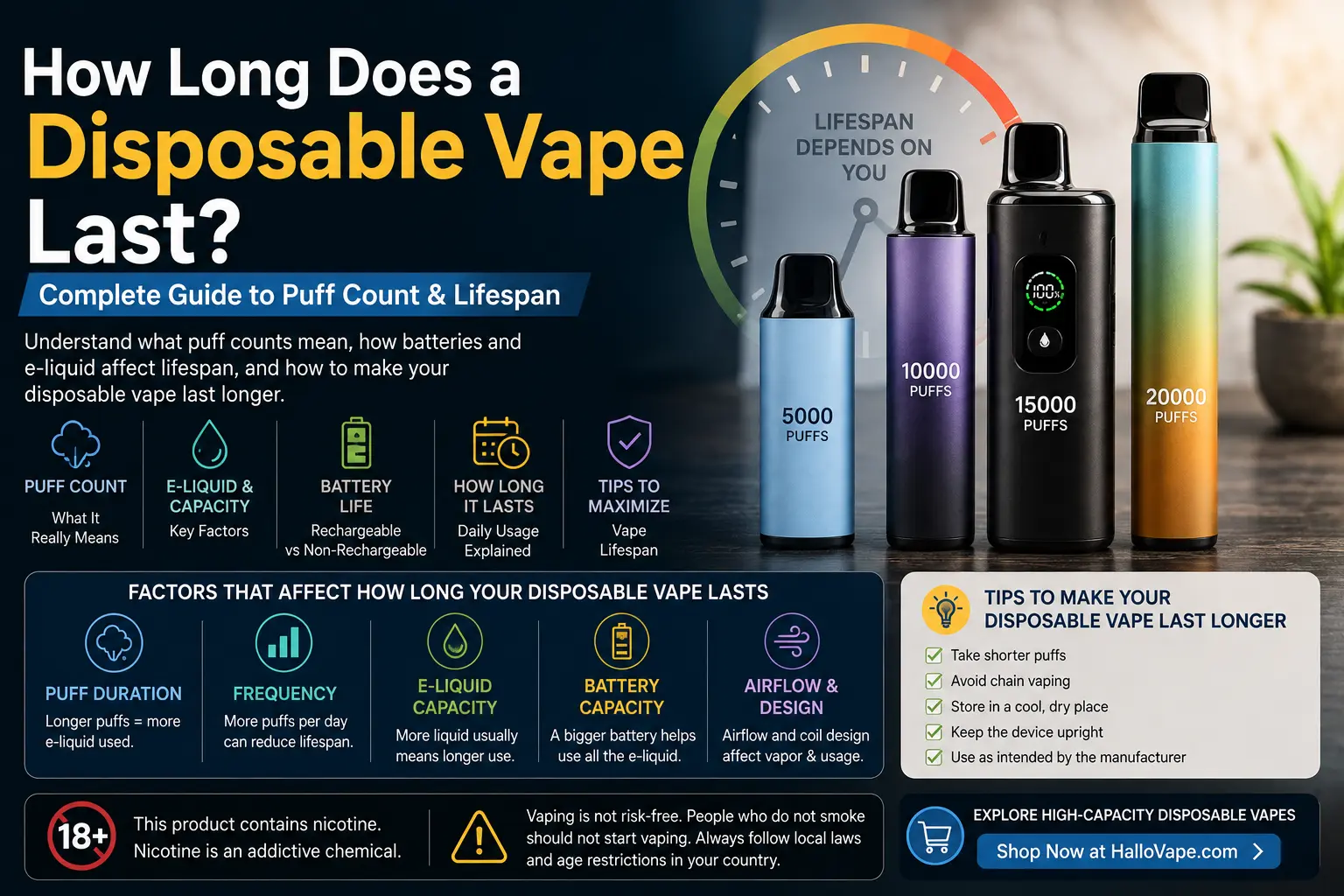
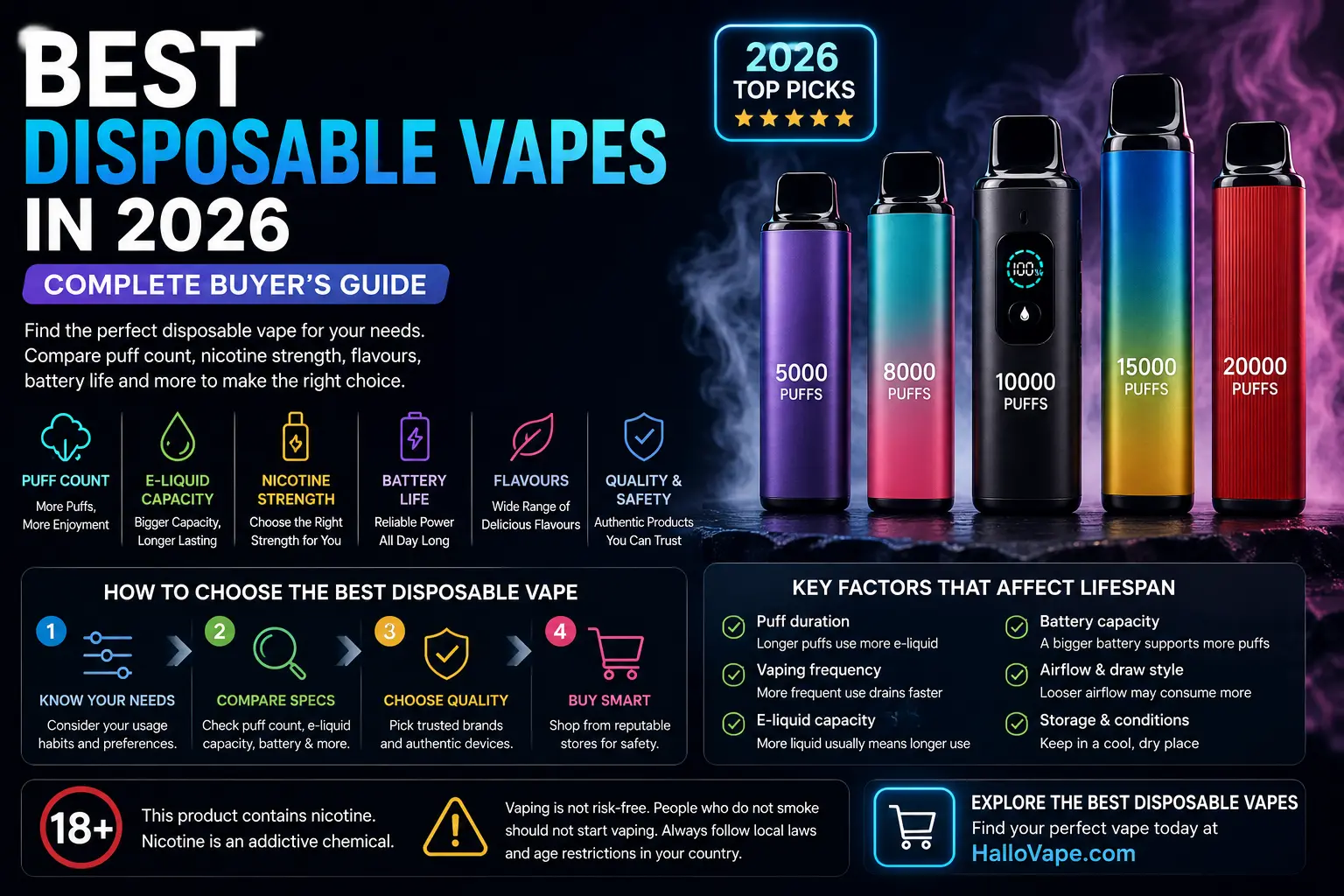
Modern disposable vapes are often advertised using large puff numbers such as 5,000, 10,000, 15,000 or even higher.
A puff rating is generally an estimate of how many puffs the device may provide under particular testing conditions.
It does not mean that every person will get exactly that number of puffs.
More importantly, puff count does not directly tell you how much nicotine will be absorbed.
A person taking short, occasional puffs may use a device very differently from someone taking long, frequent puffs.
Therefore, when comparing products, look at both the nicotine concentration and the amount of e-liquid rather than relying only on the advertised puff count.
Nicotine in Disposable Vapes
Disposable vapes have become popular because they are simple to use and do not require the same setup associated with refillable devices.
Depending on the market and product, a disposable vape may contain a specified nicotine concentration and a defined quantity of e-liquid.
For example, the label might show:
- Nicotine strength
- E-liquid volume
- Estimated puff count
- Battery information
- Flavour
These specifications should be considered together.
A product with a very large puff count may contain more e-liquid than a smaller device, while two products with the same nicotine percentage may contain very different total amounts of nicotine because their liquid capacities differ.
How to Read a Vape Nicotine Label
When buying or comparing a vape, look for three important pieces of information.
1. Nicotine concentration
This may be written as mg/mL or as a percentage.
For example:
20 mg/mL = approximately 2%
50 mg/mL = approximately 5%
2. E-liquid volume
This tells you how much liquid the device contains.
It is commonly expressed in millilitres, such as 2 mL, 5 mL, 10 mL or another stated amount depending on the product and market.
3. Product specifications
Look at the device type, estimated puff count and other manufacturer specifications.
These details help you understand how the product is designed to be used.
How to Calculate the Nicotine Contained in a Vape
If you know the nicotine concentration and e-liquid volume, you can calculate the approximate amount of nicotine contained in the liquid.
The basic formula is:
Nicotine concentration × e-liquid volume = total nicotine contained in the liquid.
For example:
20 mg/mL × 5 mL = 100 mg.
Another example:
50 mg/mL × 10 mL = 500 mg.
These calculations describe the nicotine contained in the e-liquid. They do not represent the amount a person necessarily absorbs.
Why the Vape Device Matters
The device itself can have a significant effect on nicotine delivery.
A compact pod or disposable device may operate very differently from a powerful refillable vape.
Factors such as airflow, coil design, power output and e-liquid formulation can influence the amount of aerosol generated during each puff.
This means that comparing two products only by nicotine percentage can be misleading.
For example, two products may both be labelled 2%, but their overall vaping experience and nicotine delivery can still differ because the devices are designed differently.
How Does Vape Nicotine Compare With Cigarettes?
Cigarettes and vapes deliver nicotine in different ways.
A cigarette contains tobacco and produces smoke through combustion. Vaping products heat an e-liquid to create an aerosol rather than burning tobacco.
Nicotine is the addictive substance responsible for dependence, but nicotine is not the only substance involved in cigarette smoke.
Combustion produces a complex mixture of chemicals, which is one of the major reasons cigarette smoking is so harmful.
For adult smokers who completely switch away from combustible cigarettes, vaping can reduce exposure to many of the harmful substances associated with cigarette smoke. However, vaping is not risk-free and does not make nicotine harmless.
For this reason, the goal for an adult smoker should not be to assume that vaping is harmless, but to understand the relative risks and make informed choices.
Choosing Nicotine Strength When Switching From Cigarettes
Adult smokers sometimes use vaping as a way to move away from combustible cigarettes.
One challenge is finding a nicotine strength that provides enough nicotine to make the transition practical without simply choosing the strongest available product.
There is no universal nicotine strength that works for every smoker.
Someone who smokes heavily may have very different nicotine requirements from someone who smokes only a few cigarettes a day.
Device type also matters. A compact pod device and a powerful refillable device can deliver nicotine differently even when the liquid concentration appears similar.
The most useful approach is to understand the product specifications and pay attention to how frequently the device is being used.
What About Smoking and Vaping at the Same Time?
Some smokers initially vape while continuing to smoke cigarettes.
This is commonly called dual use.
For someone trying to reduce the harm associated with smoking, simply adding vaping without reducing cigarette consumption does not provide the same potential benefit as completely switching away from combustible cigarettes.
The health difference between continuing to smoke and completely switching is important.
If someone is using vaping as an alternative to cigarettes, the objective should be to avoid assuming that occasional vaping automatically cancels out the risks of continued smoking.
Reducing cigarette consumption may be a step in a transition, but complete switching is generally the more meaningful change in terms of avoiding exposure to tobacco smoke.
Can You Reduce Nicotine Over Time?
Some adult vapers choose to reduce their nicotine concentration gradually.
This may involve moving from a higher concentration to a lower one over time.
For example, a person may eventually move from 50 mg/mL to 20 mg/mL and then to a lower concentration, depending on the products available in their market and their personal goals.
However, lowering the concentration does not automatically mean that nicotine consumption falls by exactly the same percentage.
If someone responds to a lower nicotine concentration by vaping much more frequently or taking longer puffs, their overall nicotine exposure may not decrease as expected.
For this reason, frequency of use is just as important to consider as the number printed on the bottle or device.
Common Mistakes When Comparing Nicotine Strengths
Mistake 1: Thinking 5% means 5 mg
It does not.
5% is commonly equivalent to approximately 50 mg/mL.
Mistake 2: Assuming 20 mg means the whole vape contains 20 mg
Usually, 20 mg/mL describes the concentration per millilitre.
The total amount depends on how much e-liquid the device contains.
Mistake 3: Comparing only the puff count
Puff count is an estimate and does not directly tell you nicotine absorption.
Mistake 4: Assuming higher nicotine is always better
Nicotine strength should be considered in the context of the user's existing nicotine use and the device being used.
Mistake 5: Assuming nicotine-free means risk-free
Removing nicotine does not make vaping completely harmless.
Example: Understanding the Nicotine Information on a Disposable Vape
Consider a disposable vape such as the JNR Alien 10K.
When evaluating a product like this, do not look only at the "10K" number.
The number generally refers to the manufacturer's estimated puff capacity. To understand the nicotine characteristics of the product, you should also check the product specifications for its nicotine concentration and e-liquid capacity.
This distinction is useful because a high puff rating does not automatically mean a high nicotine concentration.
Likewise, a higher nicotine concentration does not automatically mean that the device will provide a certain exact number of puffs.
If you are considering the JNR Alien 10K, you can view the product page and check the currently listed specifications before making a decision.
Explore the JNR Alien 10K
Looking for a convenient disposable vape? View the JNR Alien 10K and check its available nicotine specifications, flavours and product details.
View JNR Alien 10KNicotine and Dependence
Nicotine is an addictive substance.
Regular nicotine use can lead to dependence, meaning that a person may experience cravings or withdrawal symptoms when they reduce or stop using it.
This is an important reason why nicotine strength should not be viewed simply as a product specification.
The number printed on a package represents concentration, but nicotine dependence involves the person's pattern of use, frequency and individual response.
Someone who uses a high-strength product frequently may develop or maintain a significant level of nicotine dependence.
Adults who do not currently use nicotine should therefore not start vaping simply because a product is advertised as convenient, flavoured or high-puff.
Who Should Not Start Vaping?
Vaping products containing nicotine are intended for adults who already use nicotine, particularly adult smokers considering alternatives to combustible cigarettes.
People who do not smoke or use nicotine should not start vaping.
Young people should not use nicotine products.
Pregnant people should seek appropriate professional medical advice regarding nicotine exposure rather than relying on general online information.
Anyone who is unsure about nicotine use, dependence or how to stop should consider speaking with an appropriately qualified healthcare professional or smoking-cessation service.
Key Takeaways
If you only remember a few points from this guide, remember these:
- Nicotine strength describes concentration.
- 1% is commonly equivalent to about 10 mg/mL.
- 2% is commonly equivalent to about 20 mg/mL.
- 5% is commonly equivalent to about 50 mg/mL.
- Total nicotine depends on both concentration and liquid volume.
- Puff count does not directly tell you nicotine absorption.
- Nicotine salts and freebase nicotine are different formulations.
- Higher nicotine concentration is not automatically better.
- Vaping is not risk-free.
- People who do not smoke or use nicotine should not start vaping.
Frequently Asked Questions
How much nicotine is in a vape?
It depends on the product. Check the nicotine concentration and e-liquid volume on the packaging. Nicotine strength may be listed in mg/mL or as a percentage.
Is 2% nicotine equal to 20 mg?
In common vape labeling, 2% is approximately equivalent to 20 mg/mL. The "/mL" part is important because it describes concentration.
Is 5% nicotine equal to 50 mg?
In common labeling, 5% is approximately equivalent to 50 mg/mL.
Does 50 mg mean there are only 50 mg of nicotine in the vape?
No. If the label means 50 mg/mL, the total amount depends on the volume of e-liquid in the device.
What is the difference between 20 mg and 50 mg nicotine?
50 mg/mL has a higher nicotine concentration than 20 mg/mL. They are commonly described as approximately 5% and 2%, respectively.
Are nicotine salts stronger than freebase nicotine?
Nicotine salt and freebase describe different nicotine formulations. Nicotine salts are commonly used at higher concentrations, but the terms themselves do not simply mean "strong" and "weak."
Can nicotine strength affect how a vape feels?
Yes. Nicotine concentration and formulation can influence the vaping experience, including the throat sensation. Device design and airflow also matter.
Does a bigger puff number mean more nicotine?
Not necessarily. Puff count is an estimate of device capacity under particular conditions. It does not directly measure nicotine absorption.
Can I lower my nicotine strength?
Some adult users choose to reduce nicotine strength gradually. It is important to consider both the concentration and how frequently the device is used.
Is vaping without nicotine harmless?
No. Nicotine-free vaping is not necessarily risk-free because vaping aerosol can contain other substances.
Conclusion
Understanding how much nicotine is in a vape becomes much easier once you know the difference between nicotine concentration and total nicotine content.
Labels such as 2%, 5%, 20 mg/mL and 50 mg/mL are primarily ways of describing nicotine concentration. To understand the total amount contained in a device, you also need to know how much e-liquid it contains.
Nicotine salts and freebase nicotine can also provide different vaping experiences, particularly at higher concentrations.
For adult smokers considering a switch away from combustible cigarettes, understanding these differences can help when comparing products and reading labels. However, vaping is not risk-free, and nicotine remains addictive.
The most important distinction is between continuing to smoke combustible cigarettes and completely switching away from them. People who do not already smoke or use nicotine should not start vaping.
Always check the product packaging and current manufacturer information for the exact specifications of any vape product.
Educational disclaimer: This article is for general informational purposes only and is not medical advice. Nicotine is addictive and vaping is not risk-free. Vape and nicotine products should only be considered by adults who already use nicotine. If you are pregnant, have a medical condition, take medication, or need help stopping nicotine use, speak with a qualified healthcare professional.