Why Is My Disposable Vape Not Charging? Causes & Safety Guide
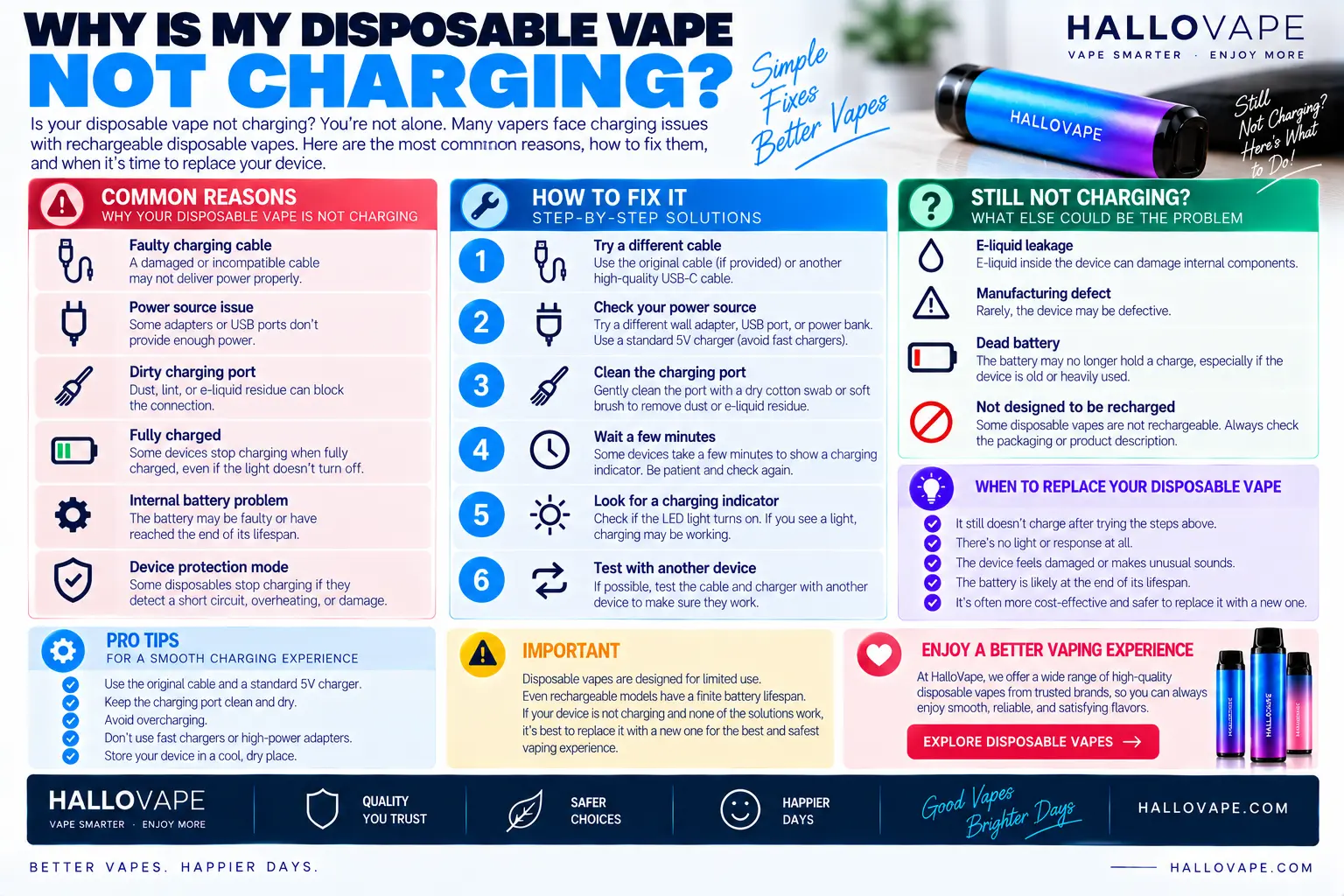
If your rechargeable disposable vape is not charging, the problem can have several possible causes. The charging cable, power source, charging port, battery condition, internal electronics or the device itself may be responsible.
Before trying anything, confirm that the device is actually designed to be rechargeable. Not every disposable vape has a charging system, and a charging port should never be added or improvised on a device that was not designed for charging.
Is Every Disposable Vape Rechargeable?
No. Some disposable vapes are designed with a non-rechargeable battery, while some disposable-style and high-capacity devices include rechargeable batteries.
A device should only be charged when the manufacturer specifically states that it is rechargeable and provides charging instructions.
The presence or absence of a charging port is not enough reason to improvise a charging method. Always check the product packaging and manufacturer information for the exact model.
Why Is My Disposable Vape Not Charging?
Common possibilities include:
- The device is not designed to be rechargeable.
- The charging cable is faulty.
- The power source is not providing power.
- The charging connection is not working correctly.
- The charging port is dirty or damaged.
- The battery has reached the end of its useful life.
- The internal charging electronics have failed.
- The device has been physically damaged.
- The battery is in a condition where charging should not continue.
The safest way to troubleshoot the problem is to start with simple external checks and avoid opening or modifying the device.
1. Confirm That the Device Is Rechargeable
This is the first thing to check.
Some disposable vapes are intended to be discarded once their battery is depleted. Others have a built-in rechargeable battery and a charging port.
Check the manufacturer's packaging or instructions. If the product is not specifically designed to be recharged, do not connect it to a power source.
If the device is rechargeable, use only the charging method specified by the manufacturer.
2. Check the Charging Cable
A damaged or faulty cable can make a working device appear to have a charging problem.
If the manufacturer specifies a particular cable or charging method, follow those instructions.
Inspect the cable for visible damage such as:
- Broken or exposed wiring.
- Damaged connectors.
- Loose connections.
- Signs of overheating.
- Physical deformation.
Do not use a damaged cable.
3. Check the Power Source
The power source can also be responsible for a charging problem.
If the device's instructions specify an appropriate power source, follow them rather than experimenting with improvised adapters or connections.
If the cable and device appear normal but there is no charging indication, the issue may be with the power source, cable, charging connection or internal electronics.
4. Inspect the Charging Port From the Outside
Dust, lint or debris can sometimes interfere with a charging connection.
Only inspect the accessible exterior of the charging port.
Do not insert needles, pins, metal tools or other sharp objects into the port. Do not attempt to bend internal contacts or physically modify the connector.
If the port is visibly damaged, loose or contaminated in a way that cannot be safely addressed externally, stop using the device and follow the manufacturer's guidance.
5. Look for a Charging Indicator
Many rechargeable devices use an indicator light or display to show charging activity.
The exact behavior varies between models. A light may turn on, change color, blink or display another charging status.
Do not assume that every device uses the same indicator pattern.
Check the instructions for your specific model if an indicator is available.
6. Give the Device Time to Respond
Some charging systems do not necessarily show an obvious response immediately.
If the device and charging setup are known to be compatible, follow the manufacturer's recommended charging procedure and observe the device for signs of normal charging.
Do not repeatedly connect and disconnect the device or experiment with different charging arrangements if the device behaves abnormally.
7. The Battery May Be Fully Depleted
A rechargeable disposable-style vape can eventually reach a very low battery state.
In some designs, a deeply depleted battery may not immediately produce an obvious indicator response.
However, this does not mean you should use an improvised charger, increase the charging power or modify the device.
Use only the charging method specified by the manufacturer.
8. The Battery May Have Reached the End of Its Life
Rechargeable batteries do not last indefinitely.
Over time, battery capacity and performance can decline. Eventually, the battery or another internal component may no longer function normally.
Signs that a device may be reaching the end of its useful life can include:
- Much shorter operation between charges.
- Inconsistent charging.
- Unexpected shutdowns.
- Reduced performance.
- Unusual heating.
- Physical changes to the housing.
If the device shows abnormal battery behavior, do not attempt to repair or replace the internal battery yourself.
9. A Damaged Charging Port Can Prevent Charging
A charging port can be affected by physical impact, pressure, moisture or repeated mechanical stress.
Visible warning signs include a loose connector, damaged housing around the port, bent contacts or a port that appears to have moved inside the device.
Do not force the connector into a damaged port.
Do not attempt to straighten internal contacts with a tool.
A damaged charging port may require replacement of the device rather than a home repair.
10. Moisture Can Cause Charging Problems
Water or e-liquid around an electrical connection can interfere with charging and may create a safety issue.
Do not charge a wet device.
If liquid has entered the device or the charging area, do not open it to dry or inspect the internal components.
Follow the manufacturer's safety guidance and local disposal guidance if the device cannot be safely returned to normal condition.
11. Can a Dirty Charging Port Stop a Disposable Vape From Charging?
It can interfere with the physical connection in some devices.
However, the correct response is not to insert sharp objects into the port.
Only perform cleaning actions that are explicitly supported by the manufacturer's instructions. If the port is damaged, wet or contaminated internally, stop using the device and seek manufacturer or retailer guidance.
12. Why Does My Vape Show No Charging Light?
A missing charging indicator does not automatically identify one specific fault.
Possible explanations include:
- The device is not rechargeable.
- The cable or power source is not working.
- The connection is not being detected.
- The battery is deeply depleted.
- The indicator itself has failed.
- The charging electronics have failed.
- The device has reached the end of its useful life.
Use the manufacturer's instructions to determine what the indicator should normally do.
13. Why Does My Vape Stop Charging After a Short Time?
If a rechargeable disposable vape begins charging and then stops unexpectedly, several factors may be involved.
The charging connection may be unstable, the battery may have a problem, the charging electronics may have failed, or the device may have reached an end-of-life condition.
Do not repeatedly reconnect a device that becomes unusually hot or behaves abnormally.
If charging repeatedly stops and the device shows other warning signs, replacement and proper disposal may be safer than continued troubleshooting.
14. Why Is My Disposable Vape Getting Hot While Charging?
Some rechargeable devices may become somewhat warm during charging, but excessive or persistent heat is not something to ignore.
Stop charging and follow the manufacturer's safety instructions if the device becomes unusually hot.
Do not continue charging a device that is:
- Swollen.
- Leaking.
- Physically damaged.
- Smoking.
- Producing an unusual smell.
- Becoming extremely hot.
For more information, read our guide on why a disposable vape gets hot.
15. Can I Use a Disposable Vape While It Is Charging?
Do not assume that a rechargeable disposable vape can be used while connected to power.
Some products may support a feature sometimes described as pass-through operation, while others do not.
Only use the device while charging if the manufacturer explicitly states that this is supported for the exact model.
If the instructions do not clearly support it, do not use the device while it is connected to power.
16. Can a New Disposable Vape Have a Charging Problem?
Yes. A new device can have a manufacturing defect, damaged charging connection, battery problem or another internal fault.
If a new rechargeable disposable vape does not charge despite following the manufacturer's instructions, do not open or modify it.
Contact the retailer or manufacturer and provide the product information they request.
17. Can Charging Fix a Vape That Has No Vapor?
If a rechargeable device has a depleted battery, charging may restore battery power and allow normal operation again.
However, charging cannot replace depleted e-liquid or repair a damaged heating element, sensor, airflow system or other failed component.
If your device has no vapor, consider the symptoms together. Our guide on why a disposable vape is not producing vapor explains common causes.
18. What If the Battery Is Dead but Liquid Is Still Inside?
This can happen because battery capacity and e-liquid capacity are separate specifications.
A rechargeable device may contain e-liquid while its battery is depleted.
If the device is specifically designed to be rechargeable, use its normal charging method. If it cannot charge normally or shows signs of damage, do not attempt to recover the remaining liquid by opening or modifying the device.
19. Can You Replace the Battery in a Disposable Vape?
Generally, a disposable vape is not designed for consumers to replace the internal battery.
Opening the housing can expose electrical components and the battery and can create avoidable safety risks.
Do not attempt to install another battery or create a custom charging connection.
If the battery has failed, the safer option is usually to follow the manufacturer's warranty, replacement and disposal guidance.
20. What Should You Do If a Disposable Vape Will Not Charge?
Use this simple checklist:
- Confirm that the device is designed to be rechargeable.
- Check the manufacturer's charging instructions.
- Inspect the cable for visible damage.
- Check the compatible power source.
- Inspect the charging port externally.
- Look for the normal charging indicator.
- Do not insert sharp objects into the port.
- Do not open or modify the device.
- Stop charging if the device becomes unusually hot or shows signs of damage.
- Contact the manufacturer or retailer if the problem continues.
When Should You Stop Troubleshooting?
Stop troubleshooting and prioritize safety if the device becomes:
- Unusually hot.
- Swollen.
- Leaky.
- Smoky.
- Physically damaged.
- Deformed.
- Associated with a strong unusual smell.
- Abnormally hot while not being used.
Do not keep charging or repeatedly activating a device that shows these warning signs.
What Not to Do When a Disposable Vape Will Not Charge
- Do not open the housing.
- Do not remove the battery.
- Do not puncture the device.
- Do not connect it to an improvised power source.
- Do not force a connector into a damaged charging port.
- Do not charge a wet or leaking device.
- Do not charge a swollen device.
- Do not deliberately heat or freeze the device.
- Do not keep charging it if it becomes unusually hot.
- Do not modify a non-rechargeable disposable vape to make it rechargeable.
How Charging Problems Relate to Device Lifespan
A charging problem does not always mean that the battery alone has failed.
Disposable-style devices contain several interconnected components. The battery, charging electronics, sensor, heating system, liquid-delivery system and airflow path can all affect the overall experience.
A device can therefore stop working normally even when one component appears to be functioning.
If the device is approaching the end of its intended service life, replacement may be more appropriate than attempting a repair.
Does Charging Make a Disposable Vape Last Forever?
No.
Rechargeability only allows the battery to be replenished within the limits of the device's design.
It does not make the e-liquid supply unlimited, and it does not prevent normal aging of the battery or other components.
A rechargeable disposable vape can eventually reach the end of its useful life because of depleted e-liquid, battery aging, heating-system problems or another component failure.
Frequently Asked Questions
1. Why is my disposable vape not charging?
Possible causes include a faulty cable, power-source problem, charging-port issue, depleted or aged battery, internal electronics failure or physical damage. First confirm that the device is designed to be rechargeable and follow its manufacturer's charging instructions.
2. How do I know if a disposable vape is rechargeable?
Check the product packaging, manufacturer information and instructions. Some disposable-style devices are rechargeable while others are not.
3. Why does my disposable vape have a charging port but not charge?
The cable, power source, port, battery or charging electronics may be responsible. A charging port does not guarantee that every connection or internal component is functioning normally.
4. Can a dead battery stop a disposable vape from charging?
A severely depleted or failed battery can result in little or no charging response. Use only the charging method specified by the manufacturer and never use an improvised power source.
5. Can I clean the charging port with a pin?
No. Do not insert pins, needles or other sharp objects into the charging port. Inspect the port externally and follow only cleaning procedures supported by the manufacturer.
6. Why does my disposable vape get hot while charging?
Some warmth may occur during charging, but unusual or persistent heat is a warning sign. Stop charging and follow the manufacturer's safety guidance if the device becomes excessively hot, swollen, damaged or otherwise abnormal.
7. Can I use my disposable vape while it is charging?
Only if the manufacturer explicitly states that the exact device supports use while charging. Do not assume that a charging port means pass-through use is supported.
8. Can I replace the battery in a disposable vape?
Disposable vapes are generally not designed for consumer battery replacement. Do not open the housing or install another battery. Follow the manufacturer's replacement and disposal guidance instead.
9. Can charging fix a disposable vape with no vapor?
Charging can restore battery power in a rechargeable device when low battery is the cause. It cannot replace e-liquid or repair a failed heating element, sensor, airflow system or other internal component.
10. When should I stop trying to charge a disposable vape?
Stop if the device is swollen, leaking, unusually hot, smoking, physically damaged, deformed or otherwise behaving abnormally. Do not continue charging a device that appears unsafe.
Conclusion
A rechargeable disposable vape that will not charge can have a simple external problem or an internal battery or electronics failure. The safest troubleshooting approach is to verify that the device is rechargeable, follow the manufacturer's charging instructions, check the cable and power source, and inspect the charging connection without modifying the device.
Do not open, puncture, crush or attempt to repair the internal battery. Never improvise a charging connection or try to make a non-rechargeable disposable vape rechargeable.
If the device becomes unusually hot, swollen, leaky, smoky or physically damaged, stop charging and prioritize safe handling and appropriate disposal.
For related information, read our guides on why a disposable vape gets hot, why a disposable vape is not producing vapor, and how long a disposable vape lasts.


