# What Is Vape Juice? Understanding E-Liquid in Disposable Vapes
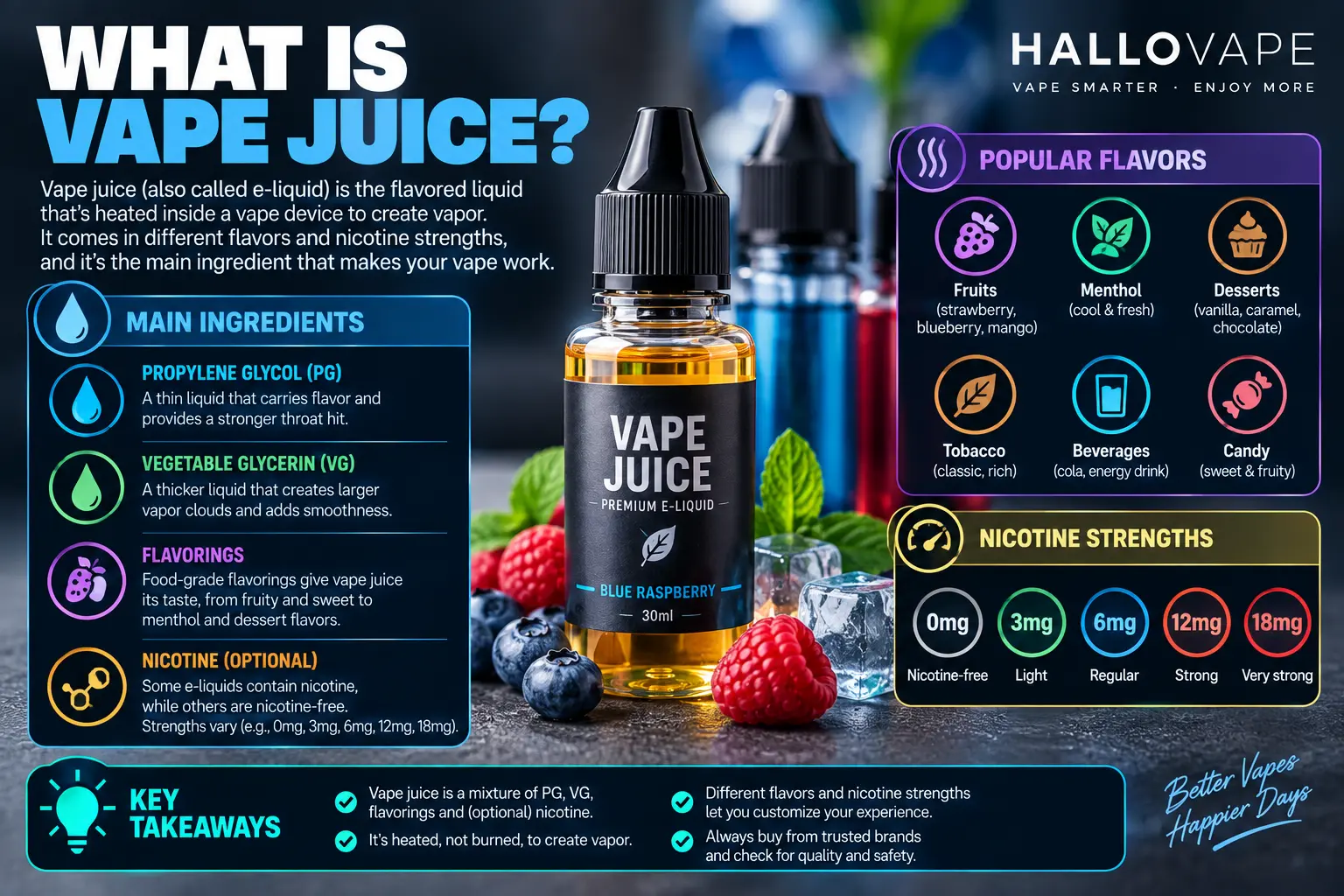
Vape juice, also called e-liquid or vape liquid, is the liquid used by a vape's heating system to produce aerosol.
In a disposable vape, the e-liquid is stored inside the device and delivered toward a heating element. When the device is activated, the heating element heats the liquid and produces an aerosol that travels through the airflow path toward the mouthpiece.
Although the process sounds simple, the liquid itself is an important part of how a disposable vape tastes, feels and performs. The formulation can influence flavor, vapor production, throat sensation, sweetness, cooling effects and how quickly the liquid is consumed.
Vape liquids can have different formulations, nicotine strengths and flavor profiles. Some contain nicotine, while nicotine-free products are also available depending on the market and product.
This guide explains what vape juice is, what it commonly contains, how it works inside a disposable vape, why different liquids behave differently and how e-liquid relates to common problems such as burnt taste, leaking and weak vapor.
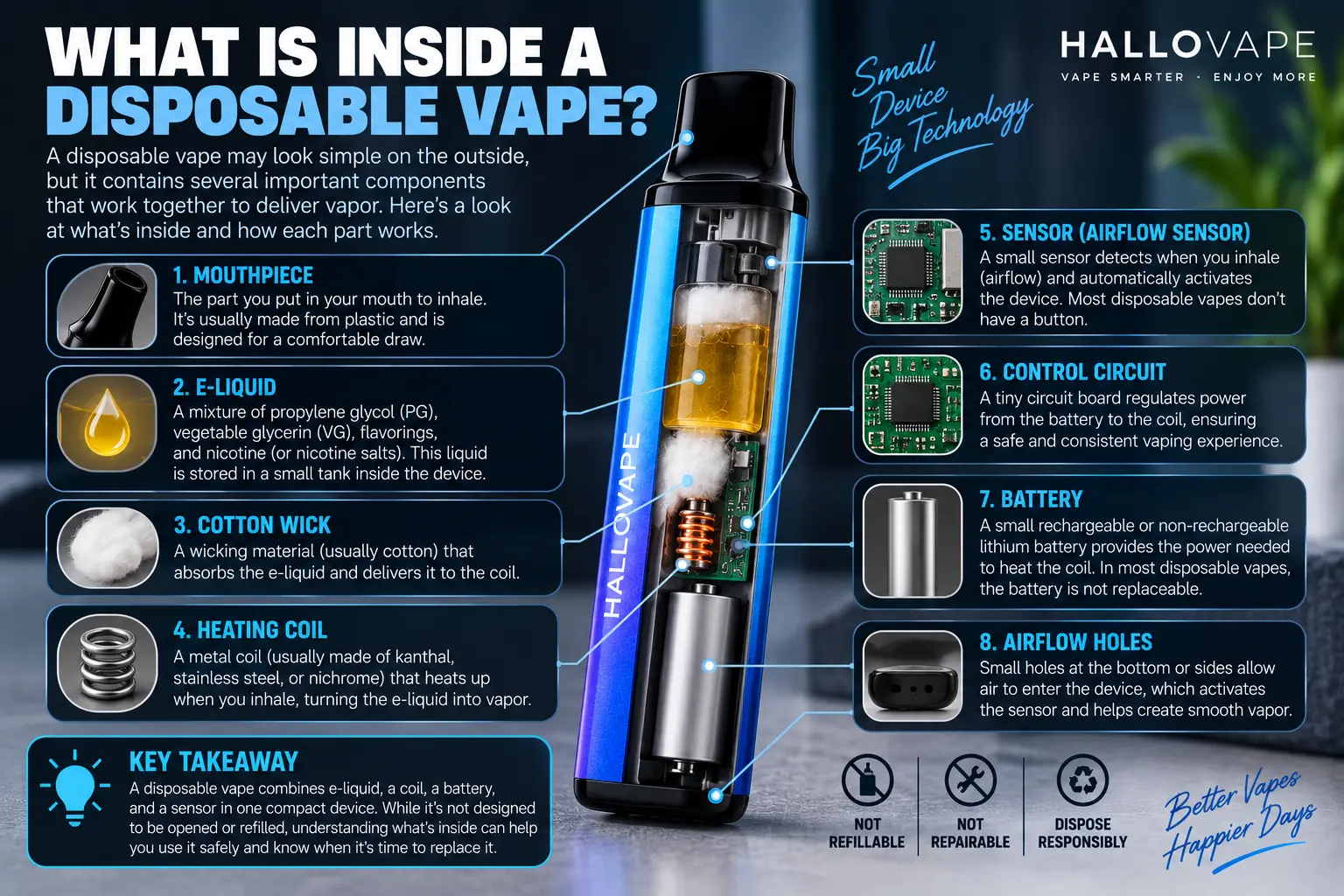
If you are new to disposable vapes, you may also want to read our guide on [how disposable vapes work](https://hallovape.com/blog/how-do-disposable-vapes-work/) and [what is inside a disposable vape](https://hallovape.com/blog/what-is-inside-a-disposable-vape/).
## What Is Vape Juice?
Vape juice is a liquid formulation designed to be heated by an electronic vaping device.
The term "e-liquid" is often used interchangeably with "vape juice."
Depending on the product, the formulation can contain a combination of:
- Propylene glycol (PG).
- Vegetable glycerin (VG).
- Flavoring ingredients.
- Nicotine, when included.
- Other ingredients permitted by the manufacturer and applicable regulations.
The exact formula varies between products.
There is no single recipe used for every disposable vape.
## What Does Vape Juice Do?
The primary role of e-liquid is to provide the material that the heating system converts into an aerosol.
The liquid also determines much of the sensory experience.
For example, the formulation can affect:
- Flavor intensity.
- Sweetness.
- Cooling sensation.
- Throat sensation.
- Aerosol production.
- How quickly liquid is consumed.
The battery and heating system are responsible for supplying energy, but without e-liquid there is no liquid formulation for the heating system to aerosolize.
## The Main Ingredients in Vape Juice
Many e-liquids are built around a base containing propylene glycol and vegetable glycerin, with flavorings and optionally nicotine.
The proportions can differ.
Some products are formulated to emphasize flavor and throat sensation, while others are designed to produce a larger visible aerosol.
The product label and manufacturer information are the best sources for the exact formulation of a particular device.
## 1. Propylene Glycol (PG)
Propylene glycol is commonly abbreviated as PG.
It is a clear liquid used in many e-liquid formulations and serves as one of the common carrier ingredients.
In vaping products, PG is often associated with a more noticeable throat sensation and is also useful for carrying flavor.
The amount of PG in an e-liquid can therefore influence how the liquid feels during use.
A higher-PG formulation may feel different from a higher-VG formulation even when both contain the same flavor.
## 2. Vegetable Glycerin (VG)
Vegetable glycerin is commonly abbreviated as VG.
It is another common base ingredient in e-liquid.
VG is generally more viscous than PG and is associated with producing a fuller, denser aerosol.
The VG proportion can therefore influence the visual amount of aerosol produced by a device.
Because VG is relatively thick, the liquid formulation also needs to be compatible with the device's liquid-delivery system.
## PG vs. VG: What Is the Difference?
A simple way to understand the distinction is:
| Ingredient | General role in e-liquid |
|---|---|
| PG | Carries flavor and contributes to throat sensation |
| VG | Contributes to aerosol production and a smoother, fuller feel |
| Flavorings | Provide the intended flavor profile |
| Nicotine | Provides nicotine when included |
The exact experience depends on the complete formulation and the device rather than on one ingredient alone.
## 3. Flavoring Ingredients
Flavorings are used to create the taste profile of an e-liquid.
Disposable vapes are available in many flavor categories, including:
- Fruit.
- Menthol.
- Mint.
- Ice or cooling profiles.
- Dessert.
- Candy-inspired profiles.
- Beverage-inspired profiles.
- Tobacco-inspired profiles.
A flavor name does not necessarily tell you the complete formulation.
Two products with similar flavor names can taste different because manufacturers can use different flavoring combinations and concentrations.
### Why Flavor Can Change
Flavor can change as a device gets older or as the e-liquid supply becomes low.
Other factors can include:
- Heating conditions.
- Liquid composition.
- Storage temperature.
- Device performance.
- Residue around the heating area.
- Changes in the user's ability to perceive flavor.
If a disposable vape suddenly tastes different, do not assume that the flavor liquid itself is the only possible cause.
## 4. Nicotine
Some vape juices contain nicotine, while others are made without nicotine.
When nicotine is present, its concentration is an important product specification.
Nicotine may be listed using different measurement systems depending on the product and market, such as a percentage or a concentration expressed in milligrams per milliliter.
These labels should not be confused with puff count.
For example, a device advertised as 10K puffs does not automatically contain a particular nicotine strength.
If you want to understand the terminology in more detail, our upcoming guides on nicotine strength and nicotine salts can provide a dedicated explanation.
## What Are Nicotine Salts?
Nicotine salts are a type of nicotine formulation used in many modern vaping products.
They are different from traditional freebase nicotine formulations in their chemical formulation and typical user experience.
Nicotine salt e-liquids are commonly associated with higher nicotine strengths and a smoother-feeling inhalation than an equivalent-strength freebase formulation, although the exact experience depends on the formulation and device.
The nicotine type is separate from the flavor itself.
A fruit flavor, for example, can be formulated using a nicotine salt or another nicotine formulation.
## Is Vape Juice the Same as E-Liquid?
In everyday vaping terminology, yes.
"Vape juice," "e-liquid" and "vape liquid" are commonly used to refer to the liquid formulation used by electronic vaping devices.
Manufacturers and retailers may prefer one term over another, but the basic concept is the same.
## How Does Vape Juice Work Inside a Disposable Vape?
The process begins with the liquid stored inside the device.
When you inhale:
1. The device detects airflow.
2. The electronics activate the heating system.
3. The heating element becomes hot.
4. E-liquid reaches the heating area.
5. The liquid is heated.
6. An aerosol is produced.
7. Air carries the aerosol through the mouthpiece.
The e-liquid is therefore only one part of a larger system.
The battery, sensor, heating element, liquid-delivery material and airflow path all have to work together.
## Where Is the Vape Juice Stored?
In a disposable vape, e-liquid can be stored in a reservoir or within a liquid-delivery structure around the heating system, depending on the design.
Some devices have a visible liquid chamber, while others are designed so that the liquid is not easily visible.
Do not open a device simply to inspect the reservoir.
Opening a disposable vape can expose the battery and internal components and can create unnecessary safety risks.
## How Does Vape Juice Reach the Coil?
The liquid-delivery system transports e-liquid toward the heating element.
Many devices use a porous material or wick that absorbs and supplies liquid to the heating area.
This process needs to remain balanced.
If liquid reaches the heating element too slowly, the device may produce a dry or burnt taste.
If too much liquid enters the airflow or heating area, users may experience gurgling, spitting or leakage.
The exact mechanism varies between devices.
## Why Does Vape Juice Affect Puff Count?
Puff count is influenced partly by how much e-liquid the device contains.
However, the amount of liquid alone does not determine the number of puffs a user will get.
Actual consumption depends on factors such as:
- Puff duration.
- Frequency of use.
- Device power.
- Heating-system design.
- Airflow.
- User behavior.
Longer draws generally use more liquid than shorter draws.
This is why advertised puff counts should be viewed as estimates rather than guarantees.
Our guide to [how many puffs are in a disposable vape](https://hallovape.com/blog/how-many-puffs-are-in-a-disposable-vape/) explains this in more detail.
## What Does a Higher E-Liquid Capacity Mean?
A larger e-liquid capacity generally means there is more liquid available for the heating system.
That can support a higher advertised puff count, assuming other device characteristics are appropriate.
However, a larger liquid capacity does not automatically mean:
- Better flavor.
- Higher quality.
- Higher nicotine strength.
- More powerful vapor.
- Longer battery life.
Each specification should be evaluated separately.
## Can a Device Run Out of Battery Before the Vape Juice?
Yes.
The battery and e-liquid are separate resources.
A device may have liquid remaining when the battery can no longer provide enough power to operate the heating system.
This can be particularly relevant for non-rechargeable devices.
Conversely, a rechargeable device may have enough battery capacity to continue operating while the e-liquid eventually runs out.
Read [how long a disposable vape lasts](https://hallovape.com/blog/how-long-does-a-disposable-vape-last/) for a practical explanation of device lifespan.
## Can Vape Juice Run Out Before the Battery?
Yes.
The opposite situation is also possible.
A device can stop providing a satisfactory vaping experience because its e-liquid supply is depleted or no longer reaches the heating area properly, even though some battery capacity remains.
Common signs can include:
- Weak flavor.
- Reduced vapor.
- Dry sensation.
- Burnt taste.
- Inconsistent performance.
If you suspect the liquid is finished, read [how to tell when a disposable vape is empty](https://hallovape.com/blog/how-to-tell-when-a-disposable-vape-is-empty/).
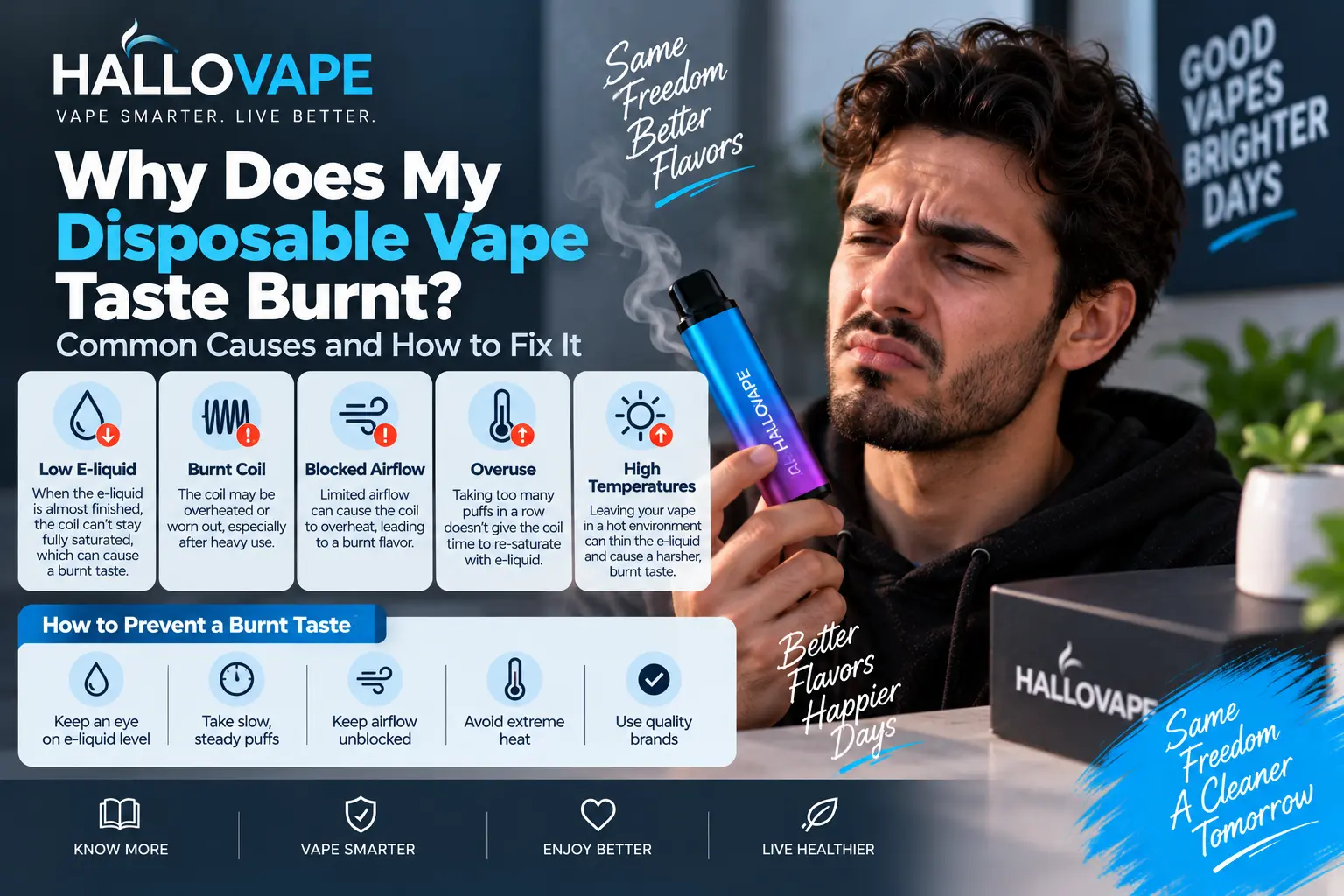
## Why Does Vape Juice Taste Burnt?
A burnt taste can happen when the heating area is not receiving enough liquid.
Possible factors include:
- Low e-liquid supply.
- Poor liquid delivery.
- Excessive repeated draws.
- A heating-system problem.
- End-of-life conditions.
A burnt taste should not be treated as a reason to take longer or more frequent draws.
If the burnt taste persists, stop using the device.
For more information, read [why a disposable vape tastes burnt](https://hallovape.com/blog/why-does-my-disposable-vape-taste-burnt/).
## Can Vape Juice Cause a Disposable Vape to Leak?
The liquid itself is part of the system, but leakage can have multiple causes.
Potential factors include:
- Damaged seals.
- Physical damage.
- Temperature changes.
- Manufacturing problems.
- Liquid entering the airflow path.
- Device construction.
A small amount of condensation around the mouthpiece is not necessarily the same as a major leak.
If a device is actively leaking, particularly together with abnormal heat or visible damage, stop using it.
See [why disposable vapes leak](https://hallovape.com/blog/why-is-my-disposable-vape-leaking/) for a dedicated guide.
## Why Does Vape Juice Sometimes Gurgle?
Gurgling can occur when liquid or condensation reaches areas of the airflow path where it should not accumulate.
Possible causes include:
- Excess liquid near the coil.
- Condensation.
- Airflow restrictions.
- Device orientation.
- Changes in liquid delivery.
If the device is producing normal vapor and the issue is minor, the sound may be related to condensation or liquid movement.
Persistent gurgling combined with significant leakage should be treated as a device-performance issue.
## Why Is the Vape Juice Too Thick?
E-liquid viscosity depends partly on its formulation.
VG is generally more viscous than PG, so a formulation with a higher VG proportion can be thicker.
Temperature can also affect viscosity.
Cooler conditions can make liquids flow more slowly, while warmer conditions can make them less viscous.
A device is designed around a particular liquid-delivery system, so not every e-liquid formulation is suitable for every device.
This is especially important when discussing refillable products.
Do not assume that a disposable vape can be refilled with a different liquid simply because liquid fits inside it.
## Can You Refill a Disposable Vape With New Vape Juice?
Some people attempt to open and refill disposable devices, but disposable products are generally designed according to their manufacturer's intended use.
Opening the device can expose the battery, damage seals and alter the airflow or liquid-delivery system.
Unless the manufacturer specifically identifies the device as refillable, do not assume it is designed for user refilling.
A purpose-built refillable pod system is different from a disposable vape.
Our comparison of [disposable vapes and pod systems](https://hallovape.com/blog/disposable-vapes-vs-pod-systems/) explains the distinction.
## What Is the Difference Between Vape Juice and Pod Liquid?
Usually, the terms describe the same general category of e-liquid.
The important difference is the device the liquid is intended for.
A refillable pod may allow the user to select a compatible e-liquid.
A disposable vape arrives pre-filled or otherwise configured by the manufacturer.
The liquid formulation needs to be compatible with the device's heating system and intended use.
## Does More VG Always Mean More Vapor?
Not necessarily.
VG is associated with aerosol production, but the amount of visible aerosol also depends on the device's heating system, power, airflow and other factors.
A high-VG formulation in a device that is not designed for it may not perform as expected.
The complete system matters more than one ingredient.
## Does More PG Mean More Flavor?
PG is commonly used as a carrier for flavorings and can contribute to throat sensation.
However, flavor intensity is not determined by PG percentage alone.
The flavoring formulation, concentration, heating conditions and device design all matter.
Two liquids with similar PG/VG ratios can still taste very different.
## Why Does the Same Vape Juice Taste Different in Different Devices?
The device changes how the liquid is heated and delivered.
Differences in:
- Heating element.
- Power.
- Airflow.
- Coil surface area.
- Draw resistance.
- Temperature behavior.
can change the resulting experience.
This is why a flavor that works well in one device may taste different in another.
## How Does Storage Affect Vape Juice?
Storage conditions can influence the condition of e-liquid and the device containing it.
Avoid unnecessary exposure to:
- Excessive heat.
- Direct sunlight.
- Extreme temperature changes.
- Physical damage.
For a disposable vape, follow the manufacturer's storage recommendations.
Do not leave the device in a hot car or in direct sunlight.
If a device has been exposed to extreme heat or shows physical damage, treat it as a potential device-safety issue rather than simply assuming the liquid has changed.
## Does Vape Juice Expire?
E-liquid can change over time.
The flavor, color and overall characteristics may change depending on the formulation and storage conditions.
For packaged products, follow the manufacturer's date information and storage guidance.
A significant change in appearance, smell or taste is a reason to stop and check the product rather than assuming it is normal.
## Why Can Vape Juice Become Darker?
E-liquid can darken over time for several reasons, including exposure to heat, light and chemical changes within the formulation.
In a device, repeated heating can also affect the liquid and nearby materials.
Color alone does not provide a complete assessment of product condition.
If the liquid has an unusual smell, the device is leaking or the product appears damaged, do not continue using it.
## What Is the Difference Between Fruit, Menthol and Dessert Vape Juice?
The primary difference is the flavor profile.
Fruit profiles aim to reproduce or evoke fruit flavors.
Menthol and mint profiles provide a cooling or fresh sensation.
Dessert profiles are designed around sweet or bakery-inspired flavor concepts.
The underlying base may still contain similar carrier ingredients.
Flavor categories are therefore mostly about the flavoring formulation rather than completely different types of liquid.
## What Are Ice Flavors?
"Ice" is commonly used in vape flavor names to indicate a cooling sensation.
An ice flavor may combine a fruit or other flavor profile with a cooling component.
The exact formulation varies by manufacturer.
"Ice" should not be interpreted as a specific universal ingredient or a fixed level of cooling.
## Why Does Vape Juice Sometimes Feel Harsh?
A harsh sensation can have several possible causes.
It can be influenced by:
- Nicotine concentration.
- Nicotine formulation.
- PG proportion.
- Flavoring.
- Heating conditions.
- Individual sensitivity.
- Device airflow.
If a device suddenly becomes much harsher than before, consider whether its performance has changed rather than assuming the liquid itself has suddenly become stronger.
## Does Nicotine Strength Change the Flavor?
Nicotine concentration and formulation can affect the overall sensory experience.
However, flavor is primarily determined by the flavoring profile and complete formulation.
A product with the same flavor name can taste different at another nicotine strength because the overall formulation may change.
Always check the actual product information rather than relying on the flavor name alone.
## What Does 0% Nicotine Mean?
A 0% nicotine product is intended to contain no added nicotine according to its labeling.
However, product labeling and regulatory requirements vary by market.
If nicotine content is important to you, check the packaging and manufacturer information for the specific product.
Do not infer nicotine content from puff count, flavor or device size.
## How Much Vape Juice Is in a Disposable Vape?
The amount varies significantly between products.
Some small devices contain a relatively small amount of e-liquid, while high-capacity disposable-style devices can contain considerably more.
The exact amount should be taken from the manufacturer's specifications.
For example, a device marketed as 10K should not be assumed to have a specific liquid volume solely from its puff-count label.
## Does a 10K Vape Have More Vape Juice?
A high puff-count product generally needs a design capable of supporting its advertised usage, and e-liquid capacity is one important factor.
But "10K" is a puff-count marketing specification, not a direct measurement of liquid volume.
The manufacturer's listed e-liquid capacity is the appropriate specification to compare.
For example, the [JNR Alien 10K](https://hallovape.com/en/product/jnr-alien-10k/) should be evaluated using its actual product specifications rather than assuming all 10K products contain the same amount of liquid.
## How Is Vape Juice Connected to Vapor Production?
The heating system converts the liquid into an aerosol.
Therefore, the liquid formulation and liquid-delivery system are directly connected to vapor production.
However, vapor production also depends on the device's electrical and airflow characteristics.
If a disposable vape is producing little or no vapor, the cause may be the battery, sensor, airflow, heating element or liquid supply.
Read [why a disposable vape is not producing vapor](https://hallovape.com/blog/why-is-my-disposable-vape-not-producing-vapor/) for troubleshooting steps.
## Is More Vape Juice Always Better?
Not necessarily.
A larger liquid capacity may provide longer potential use, but it does not automatically indicate better quality.
A good product also depends on factors such as:
- Device reliability.
- Battery performance.
- Heating-system consistency.
- Flavor quality.
- Airflow.
- Build quality.
- Product authenticity.
Puff count and liquid capacity should therefore be considered alongside the rest of the specifications.
## How to Choose a Disposable Vape Based on Its E-Liquid
When comparing products, look at the actual specifications instead of relying only on the flavor name or puff count.
Useful details include:
- E-liquid capacity.
- Nicotine strength.
- Nicotine type.
- Flavor profile.
- Puff estimate.
- Battery information.
- Rechargeability.
- Manufacturer information.
Our [complete disposable vape buying guide](https://hallovape.com/blog/how-to-choose-a-disposable-vape/) explains how to compare these factors together.
## Common Mistakes About Vape Juice
There are several common assumptions worth avoiding.
### "10K means a specific amount of liquid"
Not necessarily. Puff count and liquid capacity are different specifications.
### "A bigger device must have stronger nicotine"
Not necessarily. Device size does not determine nicotine concentration.
### "More VG always means better"
Not automatically. The correct formulation depends on the device and intended experience.
### "A dark liquid is always bad"
Color alone is not enough to determine condition.
### "If there is liquid visible, the coil must be wet"
Not necessarily. Liquid needs to reach the heating area correctly.
### "All vape juice is interchangeable"
No. Different devices and systems can require different liquid characteristics.
## Safety and Handling of Vape Juice
Vape liquid should be handled according to the product's instructions.
If a liquid contains nicotine, it should be treated as a nicotine-containing product and kept away from children and pets.
Avoid unnecessary skin or eye contact with liquid.
If liquid spills, clean the affected area appropriately and follow the product's safety information.
Do not consume e-liquid.
If accidental exposure occurs, consult the product label and appropriate local medical or poison-control guidance.
## Why You Should Not Put E-Liquid Directly on the Coil
A disposable vape is designed as an assembled system.
Adding liquid directly to an exposed heating element can cause flooding, leakage or abnormal heating and may damage the device.
Do not dismantle a disposable vape to manually wet the coil.
If the device is not delivering liquid correctly, it is safer to stop using it than to improvise a repair.
## Frequently Asked Questions
### What is vape juice?
Vape juice, also called e-liquid, is the liquid formulation used by electronic vaping devices. It commonly contains a base such as PG and VG, flavorings and, depending on the product, nicotine.
### What are the main ingredients in vape juice?
Many e-liquids contain propylene glycol, vegetable glycerin and flavoring ingredients. Some also contain nicotine. Exact formulations vary by product.
### Is vape juice the same as e-liquid?
Yes. "Vape juice" and "e-liquid" are commonly used as different names for the liquid used in vaping devices.
### What is PG in vape juice?
PG stands for propylene glycol. It is commonly used as a carrier in e-liquid and can contribute to flavor delivery and throat sensation.
### What is VG in vape juice?
VG stands for vegetable glycerin. It is a common e-liquid base ingredient associated with a fuller aerosol and a smoother feel.
### Does all vape juice contain nicotine?
No. Some products contain nicotine and others are labeled nicotine-free. Check the specific product's packaging and manufacturer information.
### Does vape juice determine how many puffs a disposable vape has?
E-liquid capacity is one factor in puff estimates, but actual puff count also depends on draw duration, device power, airflow and usage behavior.
### Why does vape juice taste burnt?
A burnt taste can occur when the heating area is not receiving enough liquid, when the device is near the end of its useful life or when the heating system has a problem.
### Can vape juice leak from a disposable vape?
Yes. Leakage can be caused by damaged seals, physical damage, temperature changes, manufacturing issues or liquid entering the airflow path.
### Can I refill a disposable vape with different vape juice?
Do not assume that a disposable vape is refillable. Unless the manufacturer specifically designed and identified it as refillable, opening and modifying the device can create safety and performance problems.
## Conclusion
Vape juice is the liquid formulation that a vaping device heats to produce an aerosol.
Most e-liquids are built around ingredients such as propylene glycol and vegetable glycerin, with flavorings and, when applicable, nicotine. The proportions and exact formulation vary between products.
Inside a disposable vape, the e-liquid works together with the battery, sensor, heating element, liquid-delivery system and airflow path. A problem with any part of this system can affect how the liquid is delivered and therefore change flavor, vapor production or draw quality.
Understanding e-liquid also helps explain why puff counts are estimates, why two devices with the same flavor can taste different and why a disposable vape can develop burnt, weak or inconsistent performance as it approaches the end of its useful life.
When evaluating a disposable vape, look beyond the flavor name and puff-count label. Check the actual product specifications, nicotine information, e-liquid capacity and manufacturer instructions.
And if a device becomes unusually hot, damaged, swollen or heavily leaky, stop using it rather than attempting to open or repair it.
Frequently Asked Questions
What is vape juice?
Vape juice, also called e-liquid, is the liquid formulation used by electronic vaping devices. It commonly contains a base such as PG and VG, flavorings and, depending on the product, nicotine.
What are the main ingredients in vape juice?
Many e-liquids contain propylene glycol, vegetable glycerin and flavoring ingredients. Some also contain nicotine. Exact formulations vary by product.
Is vape juice the same as e-liquid?
Yes. Vape juice and e-liquid are commonly used as different names for the liquid used in vaping devices.
What is PG in vape juice?
PG stands for propylene glycol. It is commonly used as a carrier in e-liquid and can contribute to flavor delivery and throat sensation.
What is VG in vape juice?
VG stands for vegetable glycerin. It is a common e-liquid base ingredient associated with a fuller aerosol and a smoother feel.
Does all vape juice contain nicotine?
No. Some products contain nicotine and others are labeled nicotine-free. Check the specific product's packaging and manufacturer information.
Does vape juice determine how many puffs a disposable vape has?
E-liquid capacity is one factor in puff estimates, but actual puff count also depends on draw duration, device power, airflow and usage behavior.
Why does vape juice taste burnt?
A burnt taste can occur when the heating area is not receiving enough liquid, when the device is near the end of its useful life or when the heating system has a problem.
Can vape juice leak from a disposable vape?
Yes. Leakage can be caused by damaged seals, physical damage, temperature changes, manufacturing issues or liquid entering the airflow path.
Can I refill a disposable vape with different vape juice?
Do not assume that a disposable vape is refillable. Unless the manufacturer specifically designed and identified it as refillable, opening and modifying the device can create safety and performance problems.