What Is Inside a Disposable Vape? Components Explained
Curious about what is inside a disposable vape? This guide explains the main components, including the battery, heating coil, e-liquid reservoir, airflow system, sensor, mouthpiece and protective electronics, and how they work together.
# What Is Inside a Disposable Vape? Components Explained
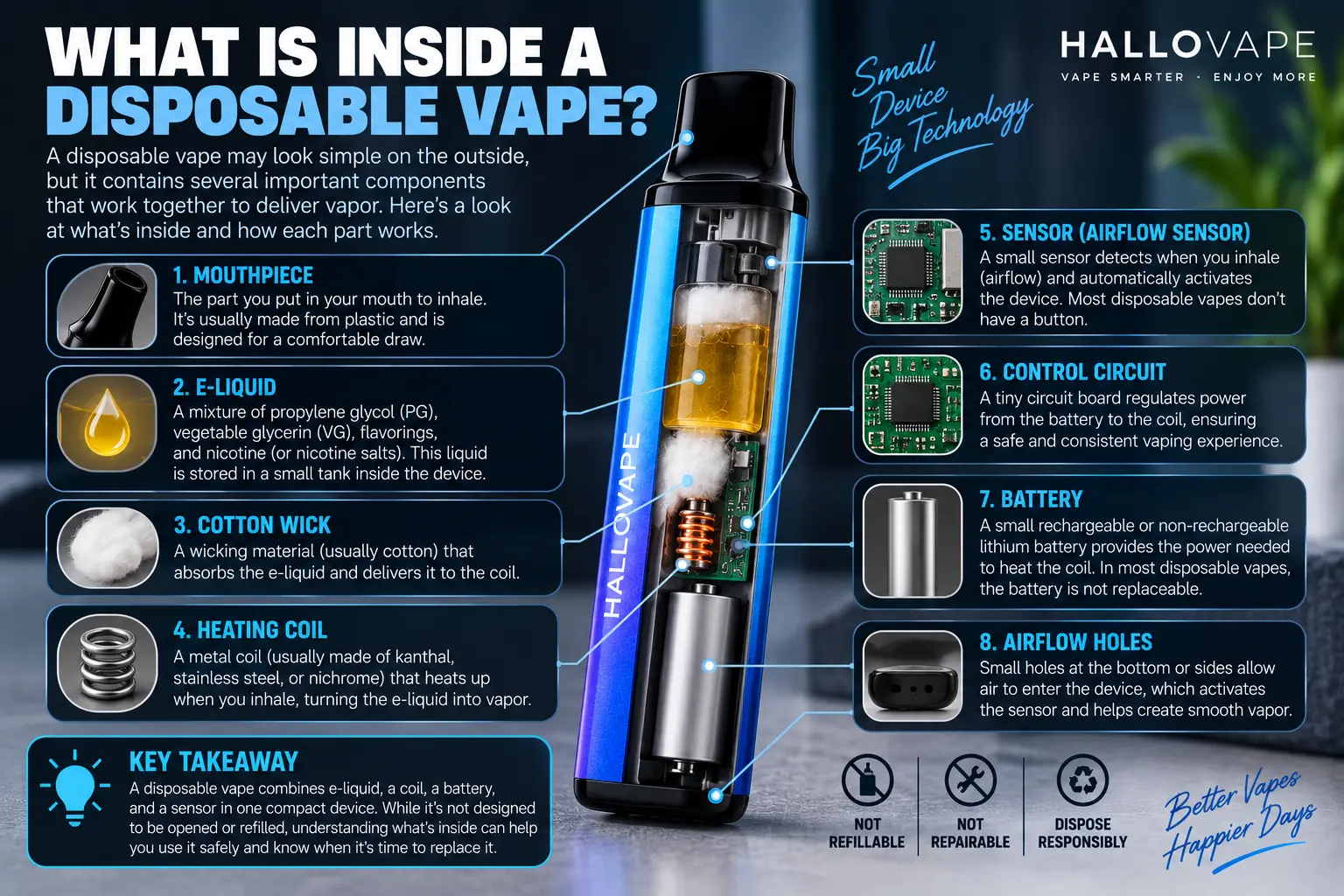
A disposable vape may look like a simple small device, but several components work together inside the housing to produce aerosol when you take a puff.
Depending on the model, a disposable vape can contain a rechargeable or non-rechargeable battery, heating element, e-liquid reservoir, airflow channels, activation sensor, control electronics and mouthpiece. Some newer high-capacity devices can also include a charging circuit, indicator lights, display components or additional electronic controls.
Understanding what is inside a disposable vape makes it easier to understand common problems such as weak vapor, burnt taste, leaking, tight airflow, charging issues and unexpected heat.
This guide breaks down the major parts in simple language and explains what each component does.
If you are completely new to the subject, start with our guide on [how disposable vapes work](https://hallovape.com/blog/how-do-disposable-vapes-work/). If you are comparing capacity labels, you can also read [what 10K puffs means on a disposable vape](https://hallovape.com/blog/what-does-10k-puffs-mean-on-a-disposable-vape/).
## The Main Parts Inside a Disposable Vape
Although construction varies between manufacturers and models, most disposable vapes are built around the same basic system:
1. Battery
2. Heating element or coil
3. E-liquid reservoir
4. Wick or liquid-delivery material
5. Airflow path
6. Activation sensor
7. Control circuitry
8. Mouthpiece
9. Outer housing
10. Charging components on rechargeable models
These parts have different jobs, but they are designed to operate as one system.
## 1. The Battery
The battery supplies the electrical energy needed to activate the heating element.
In many disposable vapes, the battery is a small lithium-based rechargeable or non-rechargeable cell, depending on the product design.
When you inhale, the device detects airflow or pressure and activates the electrical circuit. The battery then supplies power to the heating element.
Battery capacity is commonly expressed in milliamp-hours, or mAh.
A larger battery does not automatically mean a better vape. Battery capacity is only one specification and needs to be considered alongside heating power, e-liquid capacity, device size and intended use.
### Why the Battery Matters
The battery influences:
- How long the device can operate.
- How frequently the heating element can be activated.
- Whether the device can support a high puff count.
- The overall size and weight.
- Whether the product needs to be recharged.
A battery can also reach the end of its useful operating life before all of the e-liquid has been consumed.
This is one reason a device can stop producing vapor even when there appears to be liquid remaining.
## 2. The Heating Element
The heating element is the part responsible for producing the heat required to turn e-liquid into aerosol.
It is often referred to as a coil.
When electrical current passes through the heating element, its electrical resistance causes it to heat.
The element is positioned close to the liquid-delivery material so that e-liquid can reach the heated surface.
When everything is working correctly, the heating element heats the available liquid and produces aerosol that travels through the airflow path toward the mouthpiece.
### Why Coils Can Affect Flavor
The heating element plays a major role in the sensory experience of a disposable vape.
Its design, power characteristics and interaction with the liquid can influence:
- Flavor intensity.
- Vapor production.
- Warmth of the draw.
- Consistency.
- The likelihood of a dry or burnt taste when liquid delivery is inadequate.
If a disposable vape develops a burnt taste, the heating system and liquid supply are two areas to consider.
See our article on [why a disposable vape tastes burnt](https://hallovape.com/blog/why-does-my-disposable-vape-taste-burnt/) for a detailed troubleshooting guide.
## 3. The E-Liquid Reservoir
The reservoir stores the e-liquid used by the heating system.
Depending on the design, the liquid may be contained in a dedicated tank, chamber or absorbent material surrounding the liquid-delivery system.
The amount of e-liquid is one of the factors used by manufacturers when estimating a product's puff capacity.
However, the advertised puff count is not a guaranteed number of identical draws.
Puff duration, airflow, device power and user behavior can all affect how quickly liquid is consumed.
That is why a product marketed as a particular number of puffs may provide a different real-world experience for different users.
## 4. The Wick or Liquid-Delivery Material
The heating element needs a way to receive e-liquid.
Many devices use a wick or another porous liquid-delivery material positioned around or near the heating element.
The material absorbs e-liquid and keeps the heating area supplied.
This process is important because the heating element should not repeatedly operate without sufficient liquid reaching it.
If liquid delivery becomes inadequate, users may experience a dry or burnt taste.
### Why Liquid Delivery Matters
A disposable vape can have plenty of e-liquid remaining in the reservoir and still develop a performance problem if the liquid is not reaching the heating area properly.
Possible causes can include:
- Low liquid level.
- Poor liquid distribution.
- Device orientation.
- Excessive repeated activation.
- A problem with the liquid-delivery material.
- End-of-life conditions.
This is one reason simply looking through a transparent section of a device does not always tell you whether the heating system is receiving enough liquid.
## 5. The Airflow System
Airflow is the path through which air enters the device and aerosol travels toward the user.
Small openings in the housing allow air to enter.
When you inhale, air moves through the internal airflow path and across the heating area before traveling toward the mouthpiece.
Airflow design can influence the draw.
A restricted airflow path may produce a tight draw, while a more open design may feel easier to inhale through.
### What Happens When Airflow Is Blocked?
A blocked or restricted airflow path can cause:
- Tight draw.
- Reduced vapor.
- Gurgling.
- Changes in flavor.
- Unusual activation behavior.
Do not insert pins, needles or other sharp objects into the airflow openings.
Trying to physically modify the airflow can damage internal components.
If you are experiencing a tight draw, read [why a disposable vape can have a tight draw](https://hallovape.com/blog/why-does-my-disposable-vape-have-a-tight-draw/) when that troubleshooting guide is available for your site, or start with the general [disposable vape troubleshooting](https://hallovape.com/blog/why-is-my-disposable-vape-not-hitting/) guide.
## 6. The Activation Sensor
Many draw-activated disposable vapes use an airflow or pressure sensor.
Its job is to detect when the user inhales.
The sensor then signals the control circuit to activate the heating element.
This allows the device to operate without a traditional physical fire button.
### Why the Sensor Matters
If the sensor does not detect an inhale correctly, the device may fail to activate.
This can create symptoms such as:
- No vapor.
- Intermittent activation.
- Delayed activation.
- Activation that stops unexpectedly.
Condensation or liquid near the sensor area can also interfere with normal operation on some devices.
If a device is not hitting, read [why a disposable vape is not hitting](https://hallovape.com/blog/why-is-my-disposable-vape-not-hitting/).
## 7. Control Electronics
Disposable vapes can contain a small electronic control board or related circuitry.
The exact design differs from one model to another.
The electronics can control or coordinate functions such as:
- Battery power delivery.
- Sensor input.
- Heating activation.
- Indicator lights.
- Charging.
- Protective cutoffs.
Some devices have relatively simple circuitry, while more advanced models can include additional electronic functions.
The presence of electronics is one reason you should not open a disposable vape to experiment with its internal components.
## 8. Protective Circuits
Battery-powered devices can include electronic protections designed to help manage abnormal operating conditions.
Depending on the model, protections may relate to conditions such as:
- Excessive activation time.
- Short circuits.
- Overcharging.
- Low battery conditions.
- Other abnormal electrical states.
The exact protections vary by device and manufacturer.
A protection feature is not a guarantee that every fault will be prevented.
If a disposable vape becomes unusually hot, damaged or swollen, do not rely on its electronics to make continued use safe.
Read [why a disposable vape gets hot](https://hallovape.com/blog/why-is-my-disposable-vape-getting-hot/) for more information.
## 9. The Mouthpiece
The mouthpiece is the part through which the aerosol exits the device.
It is connected to the internal airflow path.
The mouthpiece may be integrated directly into the outer housing or designed as a separate component within the top section.
Because it is exposed to the user's mouth and the surrounding environment, condensation can accumulate around it.
A wet mouthpiece or gurgling sound does not automatically indicate a serious internal failure, but substantial liquid leakage should be treated differently.
## 10. The Outer Housing
The housing protects the internal components.
It can be made from different materials depending on the manufacturer and product.
The housing provides:
- Structural protection.
- A grip surface.
- Protection from everyday contact.
- Space for the battery and other components.
- Openings for airflow and charging where applicable.
The housing is not merely cosmetic.
If it becomes cracked, crushed, badly dented or separated, internal components may also be affected.
A damaged disposable vape should not be opened to see what happened inside.
## 11. Charging Components in Rechargeable Disposables
Not every disposable vape is rechargeable.
Some products are designed to be used until the battery is depleted or the e-liquid is exhausted and then discarded according to local requirements.
Other high-capacity disposable-style products include a charging port.
A rechargeable model may contain additional circuitry that manages the charging process.
This can include a charging interface and electronic controls associated with battery charging.
Always follow the manufacturer's instructions for the specific device.
Never assume that a charging port means every charging behavior is safe.
## What Happens Inside When You Take a Puff?
The process is easier to understand as a sequence.
### Step 1: You Inhale
Your inhalation creates airflow through the device.
### Step 2: The Sensor Detects the Draw
The airflow or pressure sensor detects the change.
### Step 3: The Circuit Activates the Heater
The control electronics allow battery power to reach the heating element.
### Step 4: The Heating Element Produces Heat
The coil reaches its operating temperature.
### Step 5: E-Liquid Reaches the Heating Area
The wick or liquid-delivery system supplies liquid to the heated surface.
### Step 6: Aerosol Is Produced
The heated liquid produces an aerosol.
### Step 7: Air Carries the Aerosol Through the Device
The airflow path directs it toward the mouthpiece.
### Step 8: The Draw Ends
When you stop inhaling, the sensor no longer detects the activation condition and the heating system stops.
The exact behavior varies between products, but this basic sequence explains the purpose of the main components.
## How the Components Work Together
No single component determines the complete performance of a disposable vape.
Think of the device as a chain:
**Battery → Electronics → Heating Element → Liquid Delivery → Airflow → Mouthpiece**
The sensor acts as the trigger that tells the electronics when to activate the heating system.
If one part of this chain has a problem, the symptoms can appear somewhere else.
For example, poor liquid delivery can appear as a flavor problem.
A blocked airflow path can appear as a vapor problem.
A weak battery can appear as inconsistent activation.
This is why troubleshooting should consider the whole system rather than focusing on only one component.
## What Is Inside a 10K Disposable Vape?
A high-puff-count disposable vape generally uses the same basic categories of components as other disposable devices.
The main differences may involve:
- Battery capacity.
- E-liquid capacity.
- Heating system.
- Airflow design.
- Physical dimensions.
- Electronic features.
- Rechargeability.
A larger advertised puff count does not mean the device contains a fundamentally different type of technology.
For example, a product such as the [JNR Alien 10K](https://hallovape.com/en/product/jnr-alien-10k/) should be evaluated according to its specific listed specifications rather than assuming that every "10K" device has identical internal construction.
## Does More E-Liquid Mean More Puffs?
Not necessarily.
E-liquid capacity is an important factor in puff estimates, but it is not the only one.
Actual usage depends on how the device is activated and how much liquid is consumed during each draw.
Longer draws generally consume more liquid than shorter draws.
Therefore, two users can use the same product and reach the end of the e-liquid at different times.
Read [how long a disposable vape lasts](https://hallovape.com/blog/how-long-does-a-disposable-vape-last/) for a practical explanation of the factors that influence lifespan.
## Does the Battery Control the Puff Count?
The battery can influence how long the heating system remains operational, but puff count is not simply a battery calculation.
A device may have enough battery capacity but run out of e-liquid first.
Conversely, the battery may become depleted before all the liquid has been consumed.
Manufacturers use their own testing methods to estimate advertised puff counts, and real-world results vary.
## What Happens When the Battery Dies?
If the battery can no longer provide sufficient power, the heating element cannot operate normally.
The device may:
- Stop producing vapor.
- Produce very little vapor.
- Fail to activate.
- Show a low-battery indicator on models that have one.
- Become unusable even if liquid remains.
A non-rechargeable disposable should not be opened to recover the remaining liquid.
A rechargeable model should be charged only according to its manufacturer's instructions.
## What Happens When the E-Liquid Runs Out?
When there is no longer enough usable liquid reaching the heating system, vapor production can decline and the flavor can become dry or burnt.
Eventually the device may stop producing a satisfactory aerosol.
If a device tastes burnt or dry, do not repeatedly activate it just to consume the remaining material.
See [how to tell when a disposable vape is empty](https://hallovape.com/blog/how-to-tell-when-a-disposable-vape-is-empty/) for common signs.
## Why Can a Disposable Vape Leak?
The e-liquid reservoir and airflow system have to remain properly sealed and arranged.
Leakage can happen for several reasons, including:
- Damaged housing.
- Seal problems.
- Temperature changes.
- Manufacturing issues.
- Liquid entering areas where it should not.
- Physical damage.
A small amount of condensation around the mouthpiece is not necessarily the same as a significant leak.
If liquid is escaping from the device, stop using it if the leak is substantial or accompanied by abnormal heat or other warning signs.
Read [why disposable vapes leak](https://hallovape.com/blog/why-is-my-disposable-vape-leaking/) for more details.
## Can You Open a Disposable Vape to See What's Inside?
It is not recommended.
Opening a disposable vape can expose you to sharp components, e-liquid and battery-related hazards.
It can also damage the battery or electrical connections.
Even if you are only curious about the construction, use manufacturer diagrams, product documentation or educational illustrations instead of dismantling a functioning device.
A battery-powered vape should be treated as an electronic product, not as a device intended for user repair.
## Why You Should Not Remove the Battery
The battery is an energy-storage component.
Attempting to remove it can cause physical or electrical damage.
A damaged battery can create a safety risk.
For this reason, disposable vapes should not be modified to reuse the battery or to extract components.
When the device reaches the end of its useful life, use appropriate local disposal or recycling channels for electronic devices and batteries where available.
## What About the E-Liquid Inside?
E-liquid formulations vary by product.
A typical vape liquid can contain a mixture involving a base such as propylene glycol and vegetable glycerin, flavoring ingredients and, depending on the product, nicotine.
The exact ingredients and concentrations depend on the formulation.
Always check the product packaging and manufacturer information for the exact ingredients.
Do not assume that two devices with the same flavor name have identical formulations.
## What Is the Role of Nicotine?
Some disposable vapes contain nicotine, while others are sold without nicotine depending on the product and market.
Nicotine concentration is a separate specification from e-liquid volume and puff count.
A larger puff count does not automatically mean a higher nicotine concentration.
If you want to understand nicotine terminology, a future guide on nicotine strength can help explain percentages, mg/mL and nicotine salts in more detail.
## Why Do Different Disposable Vapes Feel Different?
Two disposable vapes can contain the same broad categories of components but still feel very different.
Differences can come from:
- Airflow resistance.
- Heating-element design.
- Power characteristics.
- E-liquid formulation.
- Flavor concentration.
- Mouthpiece design.
- Device shape.
- Sensor sensitivity.
This is why comparing only puff count is not enough when choosing between devices.
Our guide on [how to choose a disposable vape](https://hallovape.com/blog/how-to-choose-a-disposable-vape/) covers the specifications that are more useful to compare.
## Can Internal Components Cause a Burnt Taste?
Yes, several internal factors can contribute.
A burnt taste may occur when the heating area is not receiving enough liquid, when the device is nearing the end of its usable life or when the heating system is not operating normally.
The burnt sensation is a performance warning.
Do not try to solve it by taking longer or more frequent draws.
## Can Internal Components Cause Weak Vapor?
Yes.
Weak vapor can be associated with:
- Low battery power.
- Low e-liquid supply.
- Airflow restriction.
- Sensor problems.
- Heating-system problems.
- End-of-life conditions.
The correct cause depends on the symptoms.
If the device is not producing vapor at all, see [why a disposable vape is not producing vapor](https://hallovape.com/blog/why-is-my-disposable-vape-not-producing-vapor/).
## Can Internal Components Cause Overheating?
They can.
Heat is a normal part of the heating process, but excessive or persistent heat can indicate abnormal operation.
Possible factors include repeated activation, high ambient temperature, charging conditions, restricted airflow, physical damage or a battery-related fault.
If the device becomes unusually hot, stop using it rather than opening it to investigate.
## A Simple Internal Diagram in Words
You can picture a typical disposable vape like this:
**Mouthpiece**
↓
**Airflow channel**
↓
**Heating area / coil** ← **Wick / e-liquid supply**
↓
**Air intake**
And alongside the heating system:
**Battery** → **Control electronics** → **Heating element**
**Inhale** → **Sensor detects airflow** → **Electronics activate heater**
This simplified model explains most of the basic behavior you see while using a disposable vape.
## Frequently Asked Questions
### What is inside a disposable vape?
A typical disposable vape contains a battery, heating element, e-liquid reservoir or liquid-delivery material, airflow channels, activation sensor, electronic controls, mouthpiece and protective housing. Rechargeable models may also contain charging circuitry.
### Does every disposable vape have the same parts?
No. Most use the same basic categories of components, but construction, battery type, heating system, airflow design and electronics can vary significantly between models.
### Is there a coil inside a disposable vape?
Many disposable vapes use a heating element commonly called a coil. It heats the e-liquid delivered to the heating area and produces the aerosol.
### What is the battery used for?
The battery provides electrical energy to the heating system. Depending on the model, it may be rechargeable or non-rechargeable.
### What makes a disposable vape produce vapor?
The battery powers the heating element, the liquid-delivery system supplies e-liquid to the heating area, and the airflow system carries the resulting aerosol toward the mouthpiece.
### What happens if the airflow is blocked?
A blocked or restricted airflow path can cause a tight draw, reduced vapor, gurgling or other changes in performance. Do not insert sharp objects into the device to clear internal passages.
### Can I open a disposable vape?
Opening one is not recommended. It can expose you to the battery, electrical components and liquid and can create avoidable safety risks.
### What happens when a disposable vape runs out of e-liquid?
Vapor production can decline and the device may develop a dry or burnt taste. Eventually it may no longer provide normal performance.
### Can a disposable vape have a rechargeable battery?
Yes. Some disposable-style or high-capacity devices include rechargeable batteries and a charging port. Others are designed to be discarded when their battery is depleted.
### Is the puff count determined only by the amount of e-liquid?
No. Puff estimates depend on more than liquid capacity. Draw duration, device power, airflow and user behavior can all influence actual usage.
## Conclusion
A disposable vape is a compact electronic system made from several coordinated components.
The battery provides energy, the sensor detects a draw, the electronics control activation, the heating element produces heat, the liquid-delivery system supplies e-liquid, and the airflow path carries aerosol toward the mouthpiece.
The exact internal design differs between products, which is why specifications and manufacturer instructions are important when evaluating a particular device.
Understanding these components also makes common problems easier to recognize. Weak vapor can involve the battery, airflow or heating system. A burnt taste can point toward liquid delivery or the heating area. Leaking can involve seals or the liquid path. Excessive heat can indicate abnormal operation and should not be ignored.
Most importantly, a disposable vape is not designed to be opened and repaired by the user. If a device is damaged, swollen, unusually hot, leaking heavily or behaving unpredictably, stop using it and follow the manufacturer's safety and disposal guidance.
FAQ
Frequently Asked Questions
What is inside a disposable vape?
A typical disposable vape contains a battery, heating element, e-liquid reservoir or liquid-delivery material, airflow channels, activation sensor, electronic controls, mouthpiece and protective housing. Rechargeable models may also contain charging circuitry.
Does every disposable vape have the same parts?
No. Most use the same basic categories of components, but construction, battery type, heating system, airflow design and electronics can vary significantly between models.
Is there a coil inside a disposable vape?
Many disposable vapes use a heating element commonly called a coil. It heats the e-liquid delivered to the heating area and produces the aerosol.
What is the battery used for?
The battery provides electrical energy to the heating system. Depending on the model, it may be rechargeable or non-rechargeable.
What makes a disposable vape produce vapor?
The battery powers the heating element, the liquid-delivery system supplies e-liquid to the heating area, and the airflow system carries the resulting aerosol toward the mouthpiece.
What happens if the airflow is blocked?
A blocked or restricted airflow path can cause a tight draw, reduced vapor, gurgling or other changes in performance. Do not insert sharp objects into the device to clear internal passages.
Can I open a disposable vape?
Opening one is not recommended. It can expose you to the battery, electrical components and liquid and can create avoidable safety risks.
What happens when a disposable vape runs out of e-liquid?
Vapor production can decline and the device may develop a dry or burnt taste. Eventually it may no longer provide normal performance.
Can a disposable vape have a rechargeable battery?
Yes. Some disposable-style or high-capacity devices include rechargeable batteries and a charging port. Others are designed to be discarded when their battery is depleted.
Is the puff count determined only by the amount of e-liquid?
No. Puff estimates depend on more than liquid capacity. Draw duration, device power, airflow and user behavior can all influence actual usage.
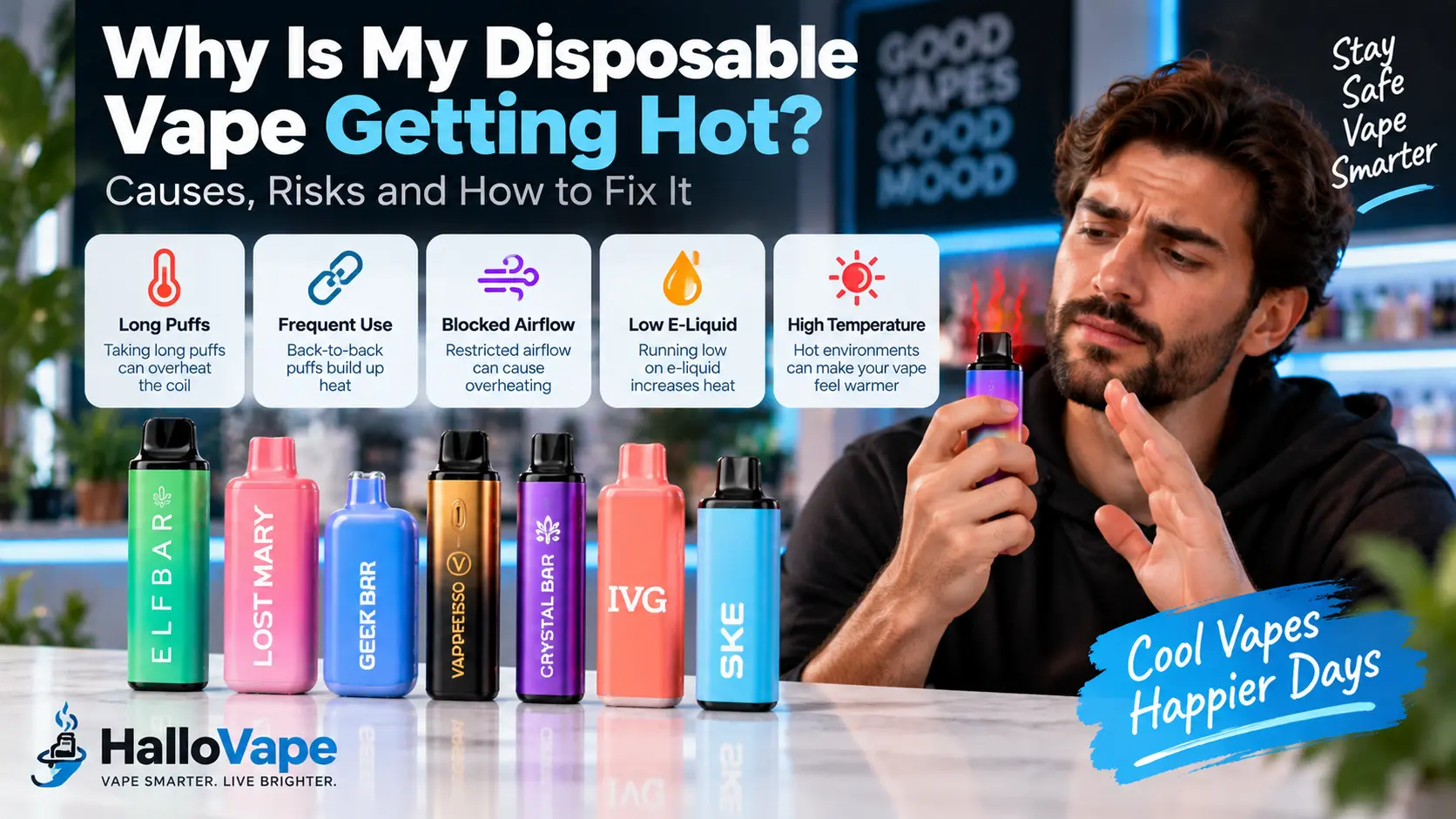
Learn why a disposable vape can feel warm or become unusually hot. This guide explains normal heat from the coil, rapid repeated use, charging, extreme temperatures, airflow problems, battery issues and physical damage, plus the signs that mean you should stop using a device.
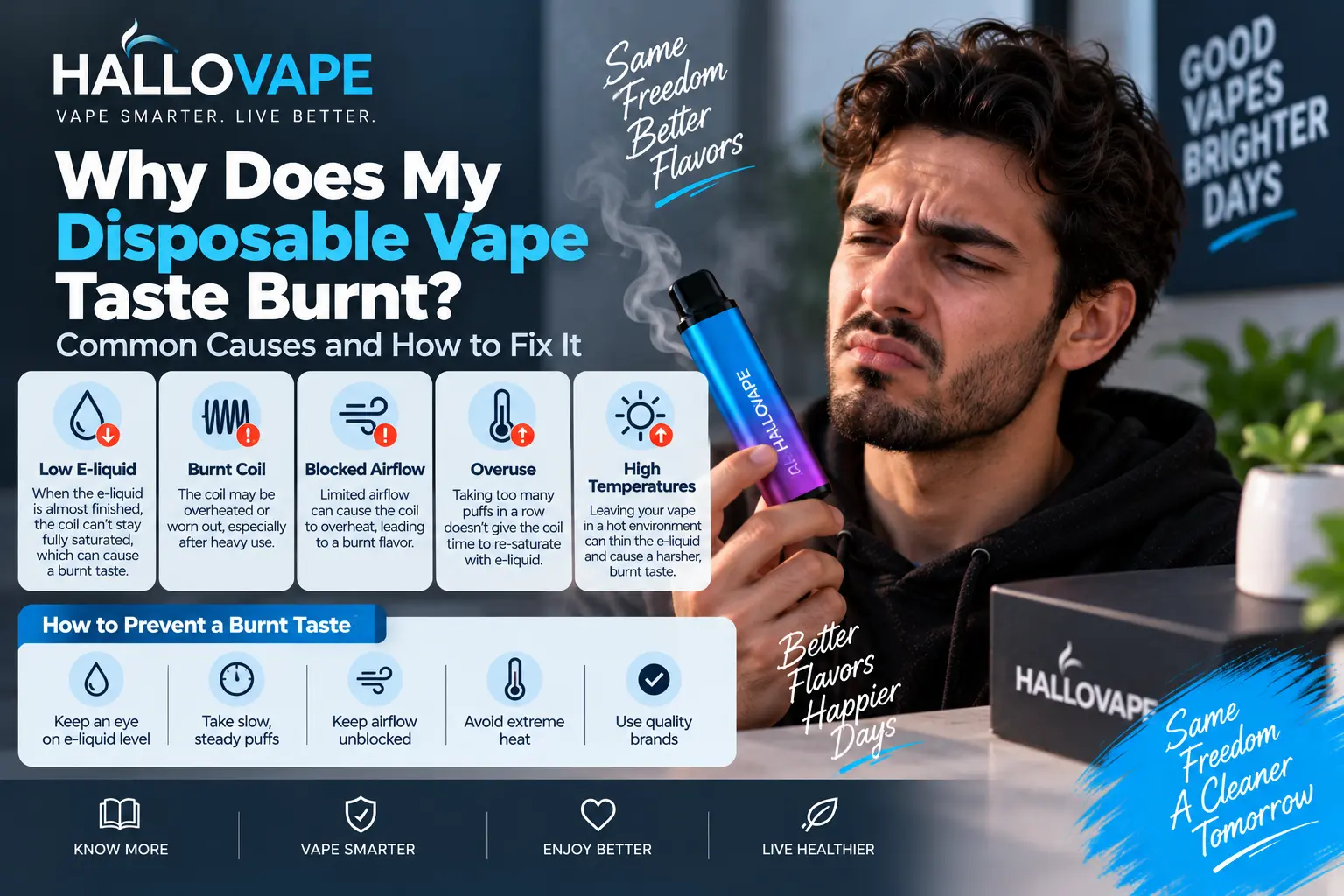
A burnt taste is one of the most common unpleasant experiences with a disposable vape. Learn why it happens, how low e-liquid, heating conditions, airflow and device age can affect flavor, and what to do when a disposable vape tastes burnt.
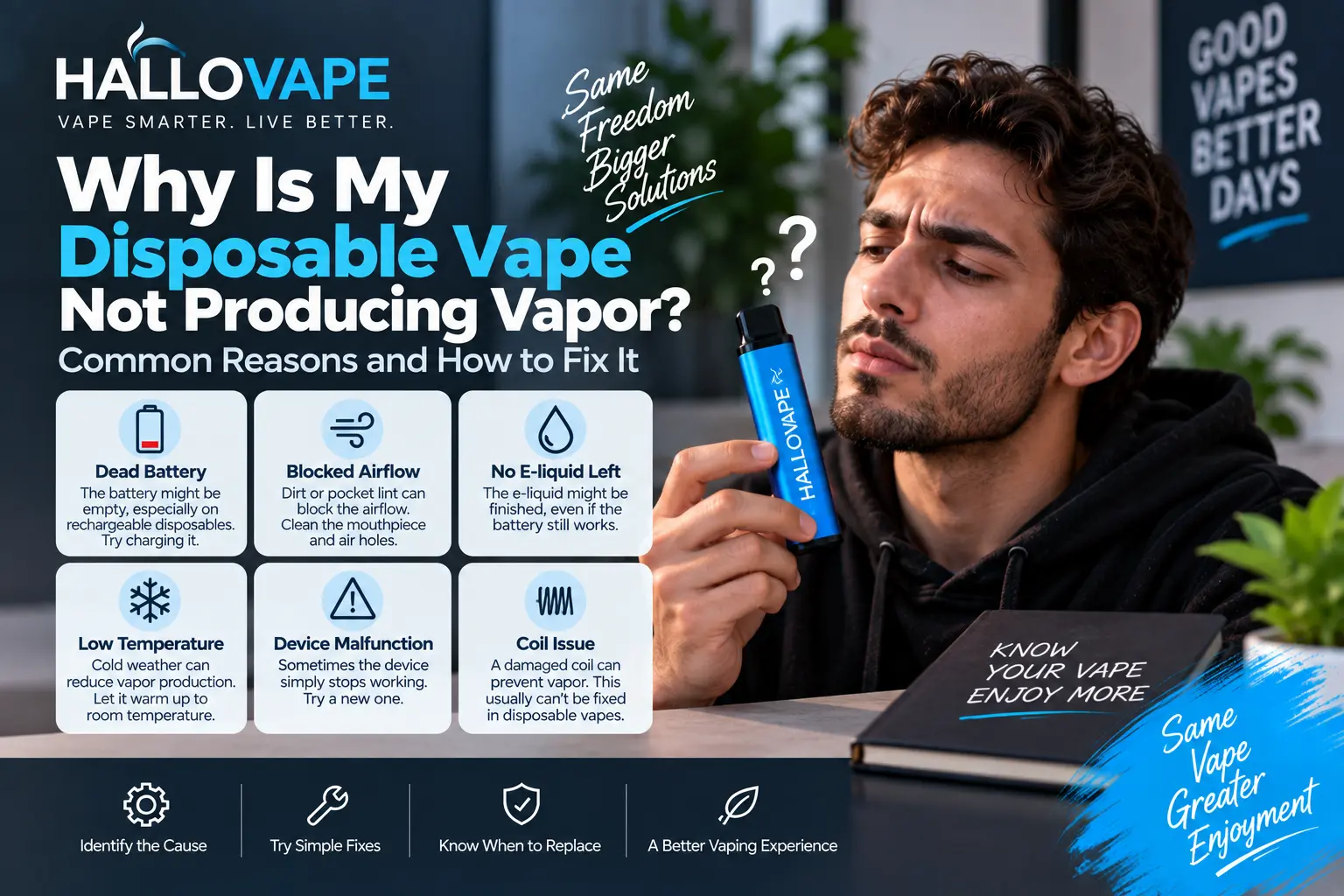
Is your disposable vape producing little or no vapor? Learn the common reasons, including a depleted battery, low e-liquid, restricted airflow, condensation, heating-element problems and device faults. This practical guide explains how to identify the likely cause and when to stop using the device.
Explore the HalloVape shop
Read, learn and then explore the products currently available at HalloVape.