What Does 5% Nicotine Mean? Nicotine Strength Explained
Nicotine strength is one of the most important numbers to understand when reading a vape label. You may see products described as 2%, 3%, 5%, 20 mg/mL or other nicotine strengths, and these numbers can be confusing if you are not familiar with the way nicotine concentration is expressed.
One of the most common labels is 5% nicotine. But what exactly does 5% mean, and how does it compare with nicotine strengths expressed in milligrams per milliliter?
In this guide, we explain what a 5% nicotine label generally represents, how percentages relate to mg/mL, how nicotine salt products fit into the picture, and why you should always check the actual product label and local regulations.
What Does 5% Nicotine Mean?
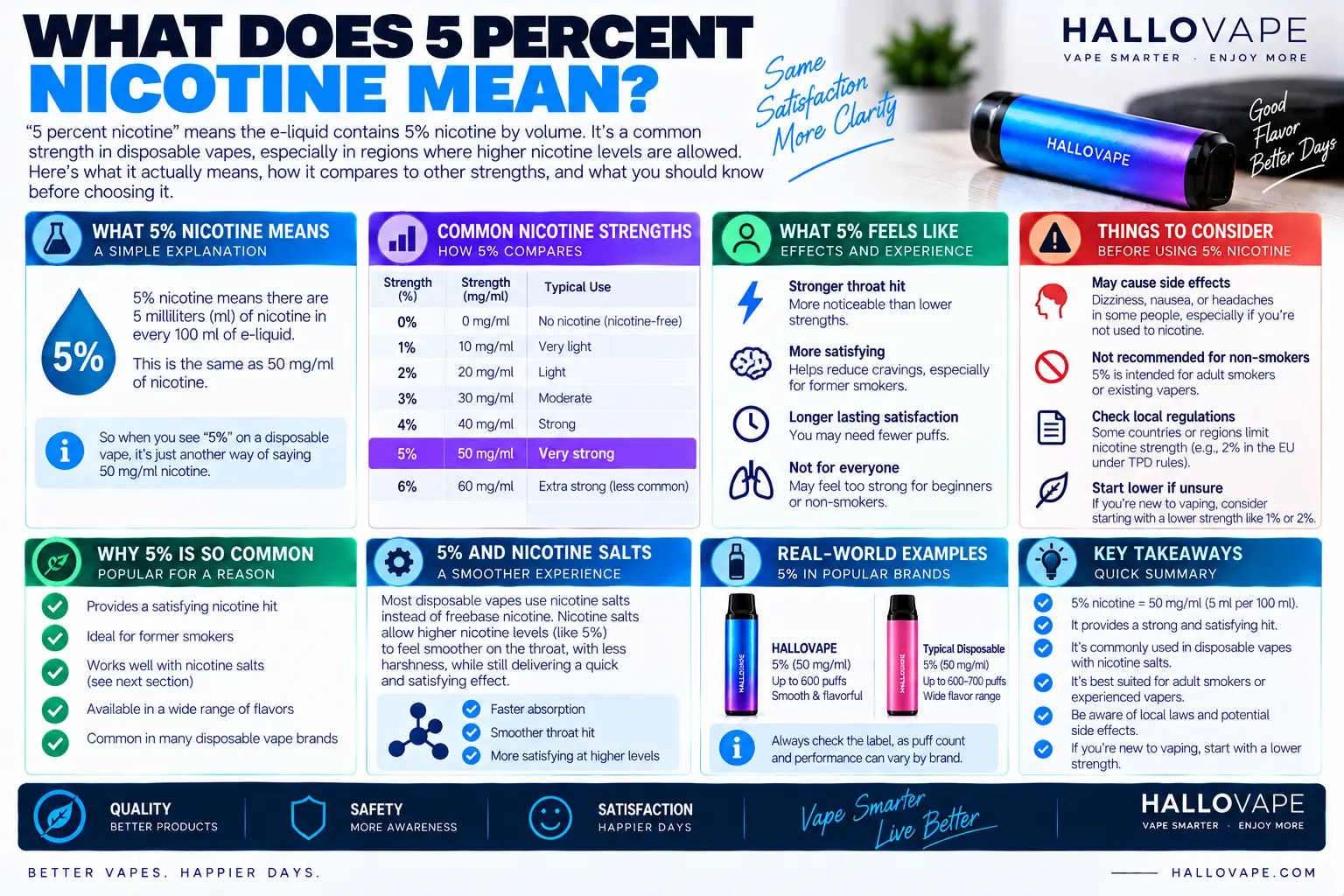
A nicotine concentration of 5% generally means that nicotine makes up approximately 5% of the e-liquid by volume.
When nicotine concentration is converted into the commonly used mg/mL format, 5% is generally equivalent to approximately 50 mg/mL.
This is a concentration measurement. It does not mean that every puff delivers 5% nicotine to the user, and it does not describe how much nicotine is absorbed from each puff.
The amount a person actually absorbs depends on several factors, including the device, e-liquid formulation, puff duration, frequency of use and individual behavior.
Is 5% Nicotine the Same as 50 mg/mL?
In common labeling conventions, 5% nicotine corresponds to approximately 50 mg/mL.
A simple way to understand the relationship is:
- 1% is approximately 10 mg/mL.
- 2% is approximately 20 mg/mL.
- 3% is approximately 30 mg/mL.
- 5% is approximately 50 mg/mL.
These conversions are useful when comparing products that use different labeling systems.
However, always check the actual packaging because labeling conventions and legal requirements can vary between markets.
Why Do Vape Brands Use Percentages?
Percentages provide a quick way to communicate nicotine concentration.
A label showing 5% immediately indicates a relatively concentrated nicotine formulation without requiring the customer to interpret a number such as 50 mg/mL.
Other products may use mg/mL instead. This can make comparisons confusing if you are not aware that the two measurements describe concentration in different ways.
Understanding both formats makes it easier to read vape labels and compare products accurately.
What Is the Difference Between 5% and 2% Nicotine?
The main difference is the concentration of nicotine in the e-liquid.
A 2% product is approximately 20 mg/mL, while a 5% product is approximately 50 mg/mL.
Therefore, a 5% formulation contains a higher concentration of nicotine per milliliter of e-liquid than a 2% formulation.
This does not mean that using one puff of a 5% product automatically results in a fixed amount of nicotine being absorbed. Puff behavior and device characteristics affect actual nicotine delivery.
What Is the Difference Between 5% and 3% Nicotine?
Using the same approximate conversion, 3% nicotine corresponds to about 30 mg/mL.
A 5% formulation therefore contains a higher nicotine concentration than a 3% formulation.
When comparing products, look at the concentration rather than assuming that a larger puff count means a stronger nicotine formulation.
What Is the Difference Between 5% and 1% Nicotine?
A 1% nicotine formulation is approximately 10 mg/mL, while 5% is approximately 50 mg/mL.
This means the nicotine concentration of a 5% product is approximately five times the concentration of a 1% formulation, assuming the labels use the same percentage convention.
Does 5% Nicotine Mean Every Puff Contains 5% Nicotine?
No.
The 5% figure describes the concentration of nicotine in the e-liquid. It does not mean that every puff consists of 5% nicotine.
A puff contains an aerosol generated from the e-liquid, and the amount of nicotine delivered and absorbed depends on the amount of liquid vaporized and other factors.
This distinction is important when interpreting nicotine labels.
How Much Nicotine Is in a 2 mL Product at 5%?
If a product contains 2 mL of e-liquid at approximately 5% nicotine, and the concentration is approximately 50 mg/mL, the theoretical total nicotine content in the liquid would be about 100 mg.
This is a calculation of the nicotine contained in the e-liquid, not the amount that a person necessarily absorbs.
Actual absorption is a separate issue and depends on how the device is used and other factors.
How Much Nicotine Is in a 10 mL Product at 5%?
Using the same approximate conversion, 10 mL at 50 mg/mL would contain approximately 500 mg of nicotine in the liquid.
Again, this is the theoretical amount contained in the e-liquid. It should not be interpreted as the amount absorbed by a user.
What Is Nicotine Salt?
Many high-strength vape products use nicotine salts rather than traditional freebase nicotine.
Nicotine salts are formulations in which nicotine is combined with an acid, commonly benzoic acid, to modify the chemical characteristics of the e-liquid.
Nicotine salt formulations are commonly associated with higher nicotine concentrations and a smoother inhalation experience compared with some equivalent freebase formulations.
For a more detailed explanation, read our guide on what nicotine salt is.
Is 5% Usually Nicotine Salt?
Many products labeled with high nicotine concentrations use nicotine salt formulations, but the percentage alone does not prove which nicotine formulation is used.
The product packaging or manufacturer information should identify whether the e-liquid contains nicotine salt or another nicotine formulation.
Do not assume that every 5% product uses exactly the same nicotine formulation.
Why Can 5% Nicotine Feel Strong?
A higher nicotine concentration can result in greater nicotine delivery under otherwise similar conditions.
Perceived strength can also depend on the nicotine formulation, device characteristics, inhalation style and individual sensitivity.
People can therefore have very different experiences with products carrying the same nicotine concentration.
Does Puff Count Tell You How Strong the Nicotine Is?
No. Puff count and nicotine concentration are separate specifications.
Puff count describes an approximate number of puffs a device may provide under particular testing conditions. Nicotine strength describes the concentration of nicotine in the e-liquid.
A device can have a high advertised puff count without necessarily having a higher nicotine concentration.
For more information, see our article on what 10K puffs means on a disposable vape.
Does a Larger Disposable Vape Automatically Have More Nicotine?
Not necessarily.
A larger device may contain more e-liquid and therefore more total nicotine if the concentration is the same, but device size alone does not determine nicotine strength.
To understand a product, look at both the e-liquid volume and nicotine concentration.
What Does Nicotine Strength Tell You?
Nicotine strength tells you the concentration of nicotine in the e-liquid.
It is useful for comparing products and understanding what is contained in the liquid, but it cannot by itself tell you exactly how much nicotine an individual will absorb.
Actual nicotine delivery is affected by device output, puff duration, frequency and other variables.
Why Is Nicotine Strength Important?
Understanding nicotine strength helps users interpret product labels and avoid confusing concentration with total nicotine content or nicotine absorption.
It also makes it easier to compare products that use different labeling systems.
For example, someone who sees one product labeled 20 mg/mL and another labeled 2% can recognize that these labels generally describe approximately the same concentration.
Can Nicotine Strength Be Compared Between Different Devices?
Nicotine concentration can be compared, but concentration alone does not provide a complete comparison of nicotine delivery.
Different devices can vaporize different amounts of e-liquid per puff. Airflow, heating power and puff duration can also influence aerosol production.
Therefore, two products with the same nicotine concentration may not necessarily deliver identical amounts of nicotine per puff.
What Does 5% Nicotine Mean on a Disposable Vape?
On a disposable vape, a 5% nicotine label generally indicates an e-liquid concentration of approximately 50 mg/mL.
The device may contain a fixed amount of e-liquid and a battery designed around that reservoir.
The total nicotine contained in the device depends on the amount of e-liquid it contains.
For example, a larger device with the same nicotine concentration can contain more total nicotine simply because it contains more e-liquid.
How Does 5% Compare With Nicotine-Free Vapes?
A nicotine-free product contains no intentionally added nicotine according to its labeling, while a product labeled 5% indicates a high nicotine concentration.
These are therefore very different products from a nicotine-content perspective.
Always read the label carefully because nicotine content is a key product specification.
Can Nicotine Strength Change Over Time?
Nicotine-containing e-liquid can undergo chemical changes over time, particularly when exposed to oxygen, light and heat.
This can affect characteristics such as color and flavor.
For this reason, proper storage is important. Read our guide on how to store a disposable vape properly for general storage information.
Does Higher Nicotine Always Mean a Better Vape?
No. Nicotine strength is a specification, not a quality rating.
A higher concentration does not automatically mean better flavor, better vapor production or a better overall product.
The appropriate product characteristics depend on the individual and the product design.
What Should You Check on a Vape Label?
When reading a vape label, look for the following information where available:
- Nicotine concentration.
- Nicotine formulation.
- E-liquid volume.
- Product manufacturer.
- Batch or product information.
- Relevant warnings and legal information.
Checking the complete label provides more useful information than looking only at the puff count or flavor name.
How to Calculate Total Nicotine in E-Liquid
The basic calculation is straightforward:
Total nicotine in milligrams = nicotine concentration in mg/mL × e-liquid volume in mL.
For example, if an e-liquid contains 50 mg/mL nicotine and the device contains 5 mL of liquid, the theoretical total nicotine content is:
50 × 5 = 250 mg.
This number represents the nicotine contained in the liquid, not the amount that will necessarily be absorbed by a person.
Why Total Nicotine and Absorbed Nicotine Are Different
The amount of nicotine contained in e-liquid and the amount absorbed by a user are not the same measurement.
Some of the e-liquid may remain unused, and nicotine delivery depends on how the device produces aerosol and how it is used.
Consequently, calculations based on e-liquid volume should not be interpreted as an exact measurement of personal nicotine exposure.
Does 5% Nicotine Mean 50 mg of Nicotine per Puff?
No.
50 mg/mL describes the approximate concentration of nicotine in each milliliter of e-liquid. It does not mean that a puff contains 50 mg of nicotine.
The amount of e-liquid consumed in a puff is much smaller than one milliliter, and actual nicotine delivery depends on the device and puff characteristics.
Why Do Some Countries Use Different Nicotine Limits?
Nicotine products are regulated differently in different countries and regions.
Some markets impose maximum nicotine concentrations, container-size restrictions, labeling requirements or other rules.
For this reason, a product available in one market may not have the same nicotine strength or packaging in another.
Always check the regulations that apply where you live or where the product is being sold.
How to Read Nicotine Strength Without Confusion
A simple approach is to convert percentage labels into mg/mL when comparing products.
For approximate conversions, multiply the percentage by 10:
- 1% ≈ 10 mg/mL.
- 2% ≈ 20 mg/mL.
- 3% ≈ 30 mg/mL.
- 4% ≈ 40 mg/mL.
- 5% ≈ 50 mg/mL.
These are approximate labeling conversions and should not replace the actual information printed on the product packaging.
Frequently Asked Questions
1. What does 5% nicotine mean?
5% nicotine generally means approximately 5% nicotine concentration in the e-liquid by volume, which is commonly expressed as about 50 mg/mL.
2. Is 5% nicotine the same as 50 mg/mL?
In common vape labeling conventions, 5% is approximately equivalent to 50 mg/mL. Always check the actual product label and applicable regulations.
3. Is 5% nicotine strong?
5% represents a relatively high nicotine concentration compared with lower-strength products. The actual nicotine delivery and perceived intensity also depend on the device and how it is used.
4. Does 5% nicotine mean 50 mg per puff?
No. 50 mg/mL describes the concentration in the e-liquid. It does not mean that each puff contains or delivers 50 mg of nicotine.
5. How much nicotine is in 2 mL at 5%?
At approximately 50 mg/mL, 2 mL would contain about 100 mg of nicotine in the e-liquid. This is the theoretical amount contained in the liquid, not the amount absorbed.
6. Is 5% nicotine usually nicotine salt?
Many high-strength products use nicotine salts, but the percentage alone does not identify the nicotine formulation. Check the manufacturer information.
7. What is the difference between 5% and 2% nicotine?
5% is approximately 50 mg/mL, while 2% is approximately 20 mg/mL. Therefore, 5% represents a higher nicotine concentration.
8. Does a higher puff count mean more nicotine?
No. Puff count and nicotine concentration are different specifications. A device can have a high puff count without having a higher nicotine concentration.
9. Can two vapes with the same nicotine strength deliver different amounts?
Yes. Device output, e-liquid consumption, puff duration, airflow and other factors can affect nicotine delivery even when the labeled concentration is the same.
10. How do I calculate total nicotine in a vape?
Multiply the nicotine concentration in mg/mL by the amount of e-liquid in mL. The result estimates the total nicotine contained in the liquid, not the amount absorbed.
Conclusion
A 5% nicotine label generally indicates a nicotine concentration of approximately 50 mg/mL. Understanding this conversion makes it easier to compare products that use percentages with products that use milligrams per milliliter.
It is also important to distinguish nicotine concentration from total nicotine content and actual nicotine absorption. The amount contained in the e-liquid is not the same as the amount a person absorbs.
When comparing vape products, check the nicotine concentration, e-liquid volume, nicotine formulation and complete product labeling rather than relying only on the advertised puff count.
Because nicotine products are regulated differently across markets, always follow the labeling and legal requirements that apply to the specific product and location.