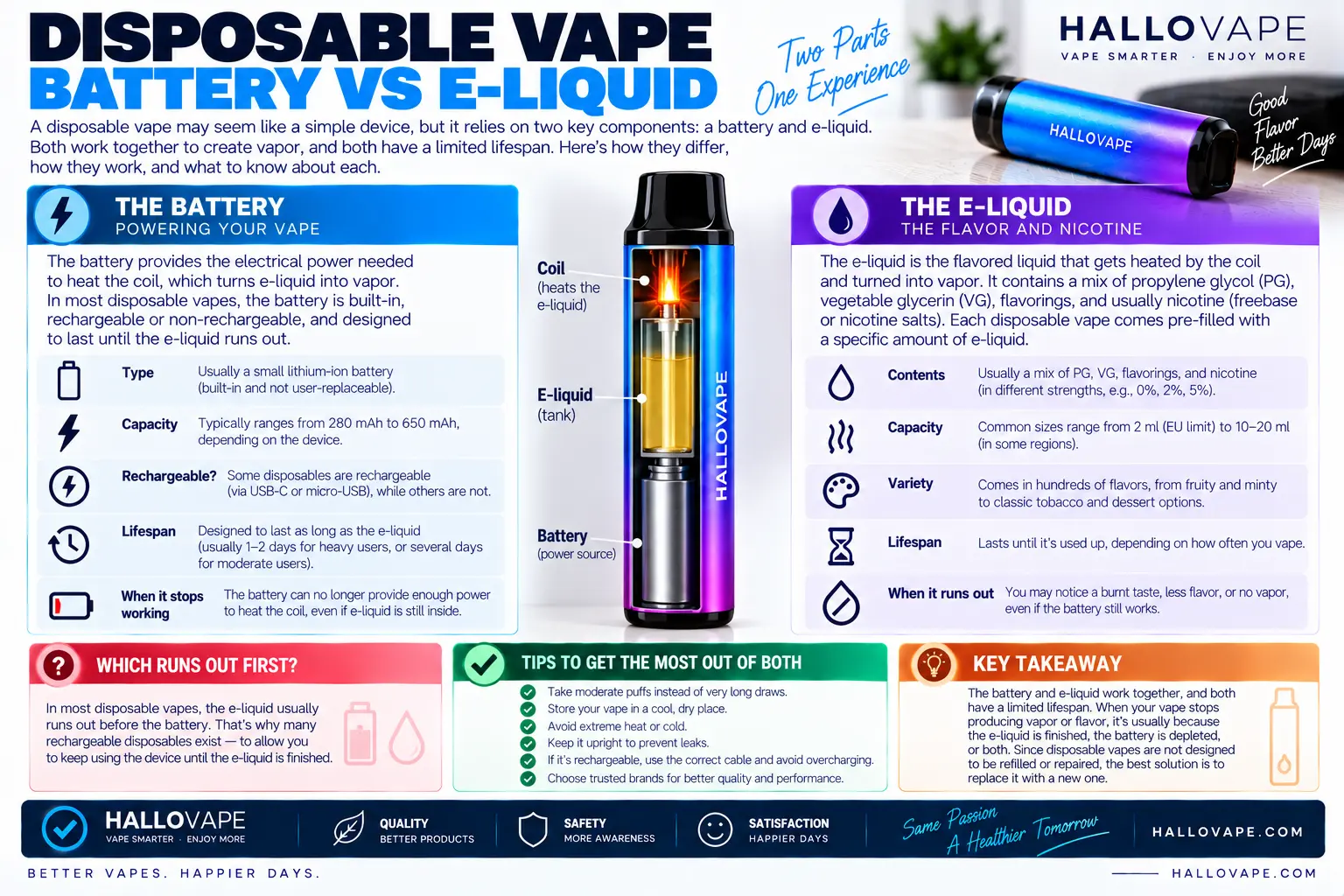
Disposable Vape Battery vs E-Liquid: Which Runs Out First?
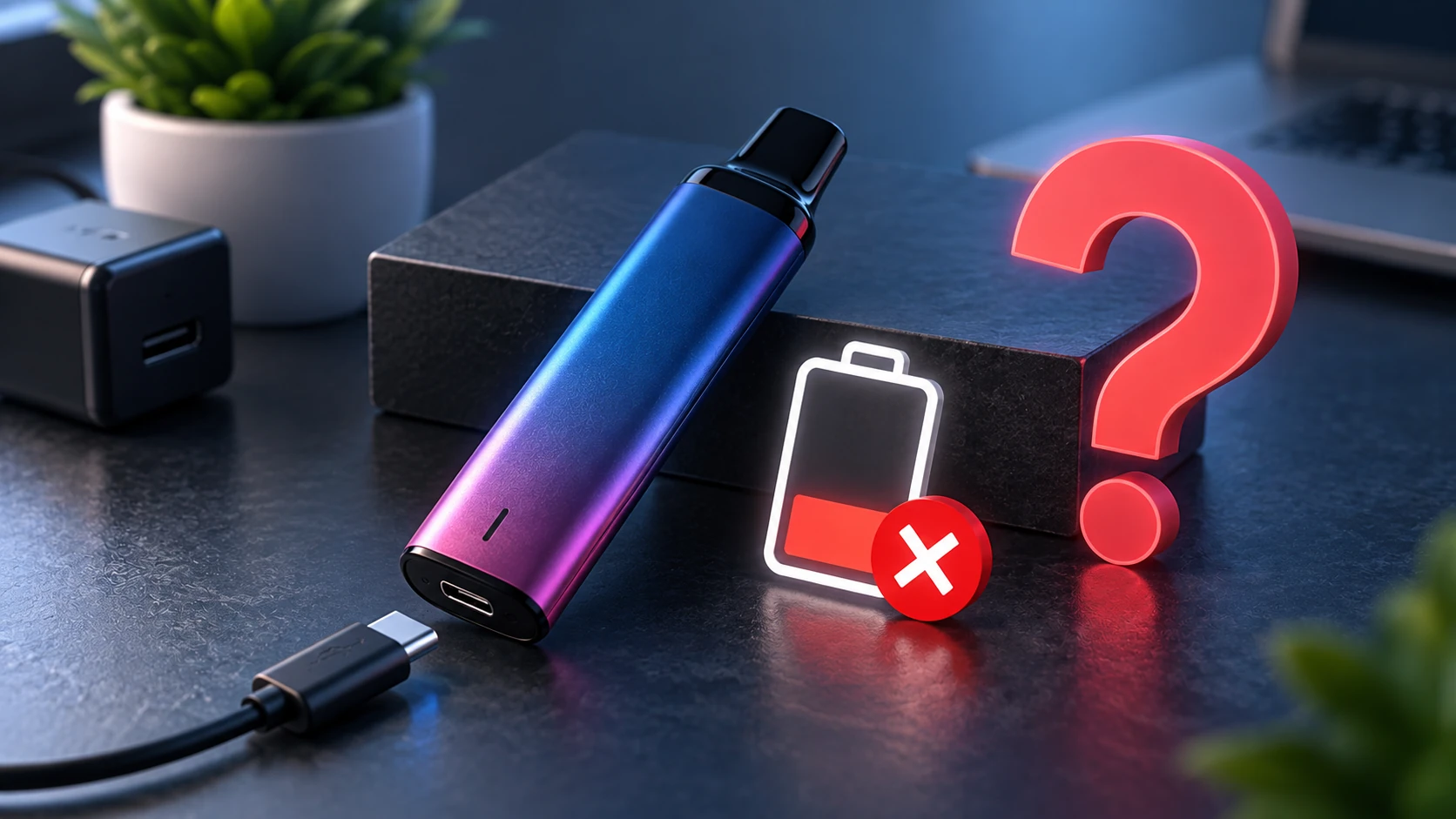
When a disposable vape stops producing vapor, many users wonder what actually ran out first: the battery or the e-liquid. The answer is not always the same because disposable vape designs vary considerably.
A disposable vape contains several components that work together. The battery supplies electrical energy, while the e-liquid provides the material that is converted into aerosol by the heating element. The device can stop providing a normal vaping experience when either of these resources reaches its practical limit.
Some devices are designed so the battery and e-liquid capacity are reasonably matched. Others may reach the end of their battery capacity before all of the e-liquid can be used, while another device may have battery power remaining after most of the e-liquid has been consumed.
This guide explains the relationship between battery capacity and e-liquid volume, the signs that each component is running low, and why the advertised puff count does not guarantee that the battery and e-liquid will always finish at exactly the same time.
What Makes a Disposable Vape Work?
A disposable vape normally combines a battery, heating element, e-liquid reservoir, airflow system and electronic control components in one device.
When the device detects an inhalation, the battery supplies power to the heating element. The heating element then vaporizes e-liquid that has reached the coil or heating surface.
For normal operation, both electrical power and e-liquid are required.
If the battery cannot provide enough power, the heating element cannot operate normally. If there is insufficient e-liquid reaching the heating element, the device may produce weak vapor or an unpleasant dry or burnt taste.
Which Runs Out First: Battery or E-Liquid?
There is no universal answer.
The battery and e-liquid capacity are selected by the manufacturer based on the design of the device. Ideally, they are balanced so that the device can provide its intended level of use without leaving a large amount of unused e-liquid.
In real-world use, however, battery life and e-liquid consumption vary.
Puff duration, frequency of use, heating power and device efficiency can all affect how quickly the available resources are consumed.
Why Battery and E-Liquid Do Not Always Finish Together
A disposable vape can contain a certain amount of e-liquid and a battery with a certain capacity, but these two specifications are not measured in the same way.
E-liquid is measured by volume, usually in milliliters. Battery capacity is related to electrical energy and is commonly described using measurements such as milliamp-hours.
The device manufacturer must therefore design the heating system and electronics so that the battery can provide enough energy for the intended amount of e-liquid.
Because real-world use differs from laboratory testing, the two resources may not always reach their practical limits simultaneously.
Signs That the E-Liquid Is Running Low
Several changes can indicate that a disposable vape is approaching the end of its e-liquid supply.
- Flavor becomes noticeably weaker.
- Vapor production decreases.
- The device begins producing a dry or harsh sensation.
- A burnt taste appears.
- The flavor becomes inconsistent between puffs.
- The device stops producing normal vapor even though it still appears to activate.
These signs can have other causes, so they should not automatically be interpreted as proof that the reservoir is completely empty.
For more information, see our guide on how to tell when a disposable vape is empty.
Signs That the Battery Is Running Low
A low battery can produce different symptoms depending on the device.
- The device may produce weaker vapor.
- The indicator light may signal low battery.
- The device may stop activating consistently.
- A rechargeable device may require charging.
- The heating element may not reach its normal operating performance.
Indicator lights vary between manufacturers, so always check the product instructions for the meaning of specific light patterns.
What Happens When the Battery Runs Out First?
If the battery reaches its usable limit before the e-liquid is exhausted, the device may stop producing vapor even though some liquid remains inside.
This can be particularly relevant with non-rechargeable disposable devices. Once the built-in battery is depleted, the remaining e-liquid cannot normally be used without electrical power to operate the heating element.
Do not attempt to access the internal battery or create an external charging connection on a device that was not designed to be rechargeable.
What Happens When the E-Liquid Runs Out First?
If the e-liquid reaches its practical limit before the battery, the device may still have electrical power but may no longer produce normal vapor.
Continuing to activate a device when the wick cannot receive enough e-liquid can produce a dry or burnt taste.
A persistent burnt taste is a reason to stop using the device rather than attempting to extract additional puffs.
Read our guide on why a disposable vape tastes burnt for more information.
Why Does a Disposable Vape Stop Working Before the Advertised Puff Count?
The advertised puff count is generally based on specific testing conditions.
Real-world puffs can vary in duration and intensity. A longer puff can consume more e-liquid and require more battery energy than a shorter puff.
Therefore, actual usage can differ from the advertised number.
The puff count should be treated as an approximate product specification rather than a guarantee of an exact number of real-world puffs.
Our guide on what 10K puffs means on a disposable vape explains this concept in more detail.
Does Taking Longer Puffs Use More Battery?
Generally, longer activation periods require the heating system to operate for a longer period.
This can consume more electrical energy and can also vaporize more e-liquid.
As a result, puff duration can influence both battery consumption and e-liquid consumption.
Does Chain Vaping Drain the Battery Faster?
Frequent use can increase the rate at which both battery energy and e-liquid are consumed.
Taking repeated puffs also gives the heating system less time between activations.
If a device becomes unusually hot during repeated use, stop using it and allow it to cool. A device that becomes excessively hot should not be ignored.
Can a Disposable Vape Have Battery Power but No Vapor?
Yes.
A device may still have enough battery power to activate while having little or no usable e-liquid reaching the heating element.
Other causes are also possible, including an airflow problem, heating element failure or an internal electronic fault.
Read our guide on why a disposable vape is not producing vapor for additional troubleshooting information.
Can a Disposable Vape Have E-Liquid but No Battery?
Yes.
A non-rechargeable disposable vape may reach the end of its battery capacity while some e-liquid remains inside the reservoir.
The remaining liquid cannot normally be used because the device no longer has enough electrical energy to operate the heating system.
Do not attempt to remove the liquid or modify the battery.
What About Rechargeable Disposable Vapes?
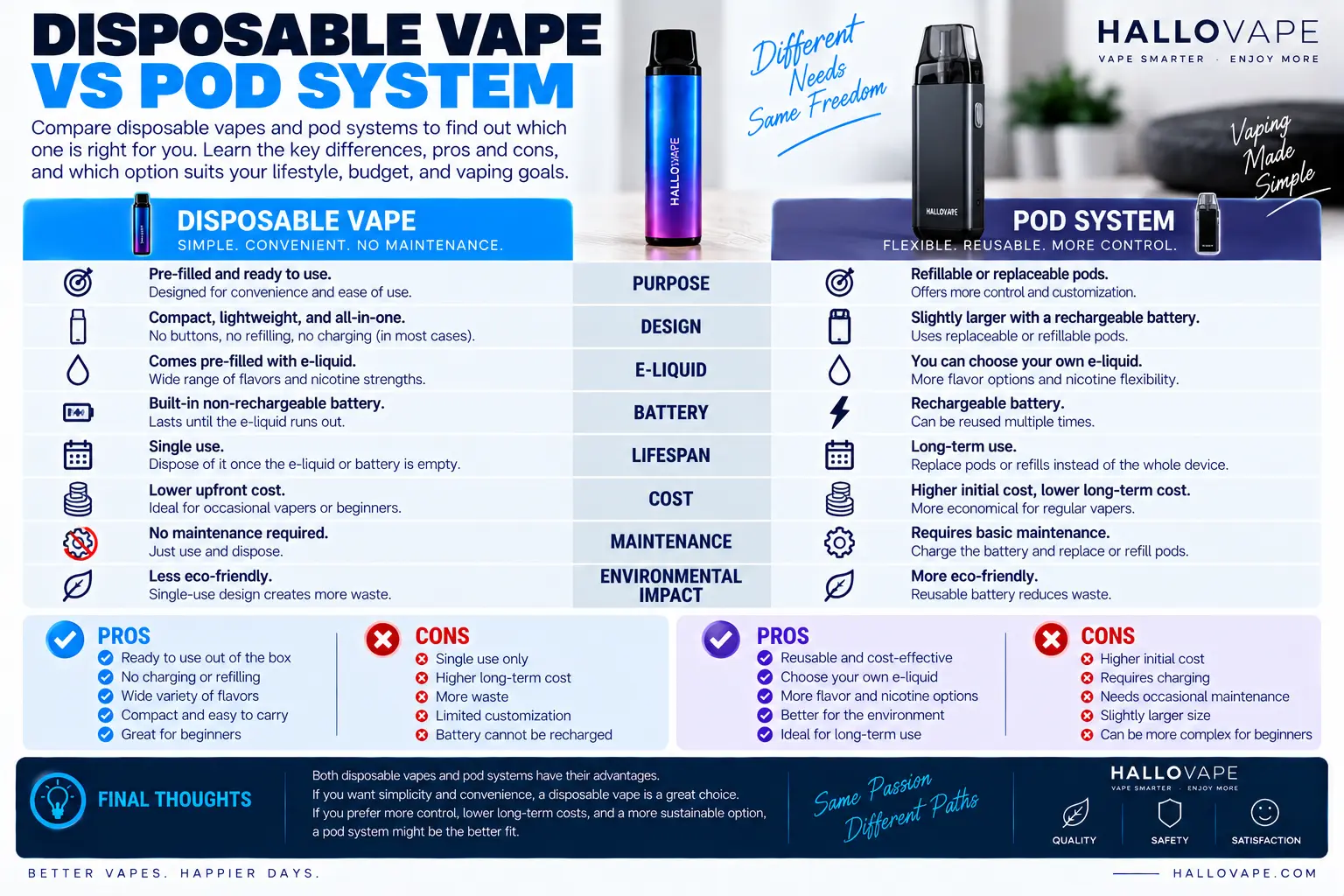
Rechargeable disposable-style devices change the relationship between battery life and e-liquid availability.
When the battery becomes low, the device can be recharged if the manufacturer designed it for recharging.
This allows the remaining e-liquid to be used after charging.
However, recharging does not add more e-liquid. Once the reservoir reaches the end of its usable supply, charging the battery will not restore normal vapor production.
For safe charging information, see how to charge a rechargeable disposable vape safely.
Does a Bigger Battery Mean More Puffs?
A larger battery can provide more electrical energy, but battery size alone does not determine the number of puffs a device will provide.
Puff count also depends on e-liquid volume, heating power, airflow, puff duration and device efficiency.
Manufacturers therefore consider multiple components when designing a high-puff device.
Does More E-Liquid Mean More Puffs?
More e-liquid can support more potential puffs, but it does not automatically guarantee a specific puff count.
If the device consumes more liquid per puff because of its heating characteristics or the way it is used, the total number of puffs can be lower.
Battery capacity also needs to be sufficient to heat the available liquid.
Why Does My Vape Taste Burnt Even Though It Has Liquid?
Visible liquid does not necessarily mean that enough e-liquid is reaching the heating element.
The wick may not be adequately saturated at the coil, or the heating element may already have been damaged.
Repeated puffs without sufficient recovery time can also contribute to a dry or burnt taste.
If the burnt taste remains, stop using the device rather than trying to continue until the reservoir is completely empty.
Why Does My Vape Stop Producing Vapor Even Though the Battery Is Charged?
A charged battery only confirms that electrical energy is available. It does not guarantee that every other component is working correctly.
The e-liquid may be depleted, the airflow sensor may have failed, or the heating element may have stopped working.
An internal electronic fault is another possibility.
Can Battery Age Affect Puff Count?
Yes. Battery performance can change as a rechargeable battery ages.
An aging battery may provide less usable capacity between charges, which can reduce the practical operating time of a rechargeable device.
If a rechargeable disposable vape has been used for a long time and the battery becomes noticeably weaker, battery aging may be contributing to the problem.
Can Storage Affect Battery and E-Liquid Life?
Storage conditions can affect both the battery and e-liquid.
Excessive heat, direct sunlight, moisture and physical damage can negatively affect the condition of a disposable vape.
Keeping the device in a cool, dry and stable environment can help reduce avoidable deterioration.
Read our guide on how to store a disposable vape properly.
Does Temperature Change Battery Performance?
Temperature can influence battery performance.
Very cold conditions can temporarily reduce battery performance, while excessive heat can place additional stress on battery components.
A disposable vape should not be deliberately exposed to extreme temperatures.
If a device has been exposed to very cold conditions, allow it to return naturally to room temperature rather than applying direct heat.
How Does Device Design Affect Battery and E-Liquid Balance?
Different disposable vapes use different battery sizes, heating systems, e-liquid volumes and airflow designs.
A high-puff device generally needs a design that balances its available e-liquid with sufficient battery capacity.
However, two devices with similar advertised puff counts can still have different internal designs and real-world performance.
Can You Tell Which Will Run Out First From the Label?
The label can provide useful information, but it may not tell you exactly which component will reach its practical limit first.
E-liquid volume and battery specifications can help describe the device, while the advertised puff count provides an approximate indication of intended usage.
Actual performance depends on how the device is used.
What Should You Do When a Disposable Vape Stops Working?
First determine whether the device is rechargeable.
If it is rechargeable and the manufacturer provides charging instructions, follow those instructions. If it is not rechargeable, do not attempt to modify or recharge it.
If the device activates but produces little or no vapor, check for signs that the e-liquid has reached the end of its usable supply.
If the device is damaged, leaking, swollen or unusually hot, stop using it.
When Should You Replace the Device?
A disposable vape should generally be replaced when it has reached the end of its usable e-liquid or battery capacity, or when it develops a fault that prevents normal operation.
Replace the device rather than attempting internal repairs if it has visible physical damage, swelling, significant leakage or persistent abnormal heat.
Disposable vapes are not designed for user repair.
Frequently Asked Questions
1. Does the battery or e-liquid run out first in a disposable vape?
There is no universal answer. Device design, battery capacity, e-liquid volume, heating system and usage behavior determine which resource reaches its practical limit first.
2. Can a disposable vape have liquid left when the battery dies?
Yes. A non-rechargeable device can stop working while some e-liquid remains because the heating system no longer has enough electrical power.
3. Can a disposable vape have battery power left when the liquid runs out?
Yes. The device may still activate even when there is insufficient e-liquid reaching the heating element.
4. Does a longer puff use more battery?
Generally, a longer activation period requires more energy because the heating system operates for longer. Longer puffs can also consume more e-liquid.
5. Why does my vape stop before the advertised puff count?
Advertised puff counts are based on specific testing conditions. Real-world puff duration, frequency and device use can produce different results.
6. Does a rechargeable disposable vape last longer?
A rechargeable disposable-style device can continue operating after the battery is recharged, provided that usable e-liquid remains and the manufacturer designed the device for recharging.
7. Why does my vape have liquid but produce no vapor?
Possible causes include insufficient liquid reaching the heating element, an airflow problem, a failed heating element or an internal electronic fault.
8. Can chain vaping drain a disposable vape faster?
Frequent use can increase both battery consumption and e-liquid consumption. Repeated activation can also increase heat in the device.
9. Does more e-liquid always mean more puffs?
No. Puff count also depends on heating power, liquid consumption per puff, airflow, puff duration, battery capacity and device efficiency.
10. When should I replace a disposable vape?
Replace it when it reaches the end of its usable battery or e-liquid supply, stops working normally, or develops signs such as damage, swelling, significant leakage or excessive heat.
Conclusion
A disposable vape needs both electrical power and e-liquid to operate normally, but the battery and e-liquid do not always run out at exactly the same time.
The result depends on the device design, battery capacity, e-liquid volume, heating system and individual usage. Longer and more frequent puffs can consume both resources faster, while storage conditions and battery age can also affect performance.
A device may therefore have battery power remaining when its e-liquid is depleted, or it may stop working because the battery is exhausted while some liquid remains.
Understanding the difference between these two resources makes it easier to interpret changes in vapor production, flavor and device performance. When a disposable vape reaches the end of its usable life or develops abnormal behavior, replace it rather than attempting to modify or repair the internal components.